


Nano Banana is Google Gemini’s native image-generation capability, and with Milvus it can support enterprise multimodal RAG by generating, indexing, retrieving, and governing visual knowledge. For teams managing product images, property photos, diagrams, screenshots, or campaign assets, Nano Banana plus Milvus turns scattered media into searchable business intelligence with stronger control over quality, rights, reuse, and scale.
Why Nano Banana Matters for Enterprise RAG
Nano Banana matters because visual content is now part of enterprise knowledge, not a design side folder. Product photos, property images, technical diagrams, and campaign mockups can answer business questions when indexed correctly.
Basic media libraries fail because they depend on file names, manual tags, and team memory. Nano Banana helps teams create and refine visuals, while Milvus helps retrieve the right version with the right context.
The goal is not to produce more images. The goal is to make visual assets searchable, reusable, and governed.
Why Milvus Is the Retrieval Layer
Milvus gives the system the structure that an image model alone cannot provide. It stores vector embeddings, supports similarity search, and pairs retrieval with metadata filtering.
For multimodal RAG, images and text can work in the same query flow. A user can search with text, a reference image, or both. Milvus retrieves assets by semantic meaning, not just keywords.
That matters in real work. A real estate team may need “approved kitchen photos with natural light.” An ecommerce team may need “latest lifestyle images for black headphones.” Folder search is too weak for these requests.
Nano Banana + Milvus Architecture
A strong Nano Banana and Milvus architecture should not feel experimental. It should work like a controlled enterprise retrieval system where every generated or edited asset is traceable.
| Layer | Role | Enterprise Value |
|---|---|---|
| Nano Banana | Creates or edits visual assets | Faster production and iteration |
| Embedding model | Converts images and text into vectors | Semantic search across formats |
| Milvus | Stores vectors and metadata | Retrieval at enterprise scale |
| Reranker | Refines search results | Prioritizes outputs based on contextual fit |
| Governance layer | Tracks rights and versions | Lower publishing risk |
This structure turns Nano Banana output into a managed knowledge asset. Milvus makes that asset findable, reusable, and connected to business rules.
The Missing Layer: Visual Provenance
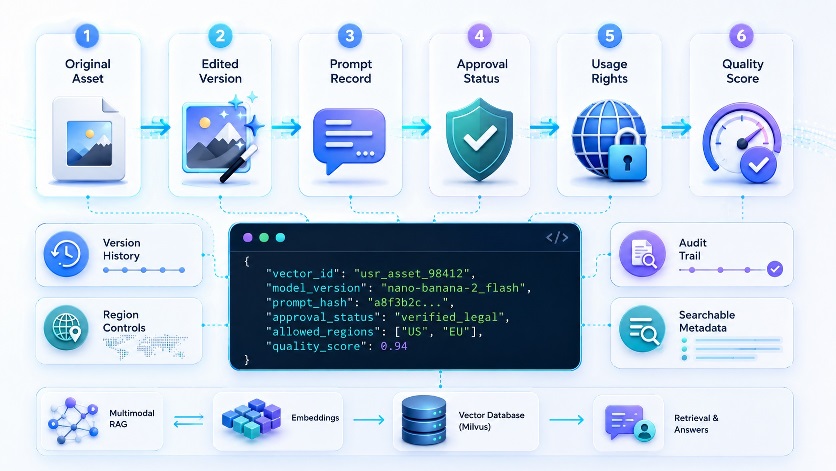
Most competitors stop at generation and retrieval. That is incomplete.
The missing layer is visual provenance. This means tracking where an image came from, how it changed, which prompt created it, who approved it, and where it can be used.
Nano Banana can create many versions quickly. While low latency enhances throughput, it simultaneously expands the system’s risk profile. Without provenance, a team may publish an outdated image, an unapproved edit, or a file with unclear usage rights.
A strong Milvus setup should store metadata beside each embedding: original asset ID, version ID, prompt history, approval status, region, copyright status, quality score, and final use case.
{
  "vector_id": "usr_asset_98412",
  "embedding_field": [0.012, -0.432, 0.911],
  "metadata": {
    "model_version": "nano-banana-2_flash",
    "prompt_hash": "a8f3b2c...",
    "approval_status": "verified_legal",
    "allowed_regions": ["US", "EU"],
    "quality_score": 0.94
  }
}
This type of payload gives technical teams a practical model for governance. It also gives business teams confidence that Nano Banana assets are not floating through the organization without ownership, review, or legal context.
Enterprise Use Cases
Real estate teams can use Nano Banana and Milvus to manage property images, floor plans, inspection photos, and campaign visuals. Agents can search by room type, lighting, location, design style, or approval status.
Ecommerce teams can use the workflow for catalog images, lifestyle shots, background variations, and localized product creatives. Instead of recreating assets, teams can find the best approved version and adapt it.
Marketing teams can search past campaigns by visual style, audience, brand color, format, or message. This reduces repeated work and protects brand consistency.
Technical teams also benefit. Diagrams, screenshots, UI flows, and training images become searchable support material. That makes Nano Banana useful beyond design and creative teams.
Scaling Without Content Risk

Enterprise AI systems should not create low-value, duplicated, or misleading content. Discipline matters.
Use Nano Banana for specific business needs, not mass visual production without review. Add human approval for public assets. Store source details. Keep captions accurate. Avoid publishing pages that exist only to target search variations.
For search-safe publishing, every asset-led page should answer a real user need. It should add original analysis, useful comparisons, implementation detail, and clear editorial judgment.
A better approach is controlled repetition. Use the main keyword where it helps the reader, then support the page with evidence, examples, and practical guidance.
Also Read: ChatGPT Guide: Practical Workflows, Risks, and Smarter Use
Final Takeaway
Nano Banana makes visual creation and editing faster. Milvus makes visual knowledge searchable, governed, and scalable.
Together, they support enterprise multimodal RAG that can handle images, text, metadata, and business rules in one retrieval workflow. The strongest setup is not the one that generates the most images. It helps teams find, trust, approve, and reuse the right visual asset.
If your organization owns large media libraries, Nano Banana plus Milvus should be treated as infrastructure. Build the provenance layer early, index assets properly, and keep humans in the approval loop.
FAQs
What does Nano Banana do in this workflow?
It functions as the core creative engine. While Milvus handles the structural search and historical context, Nano Banana acts on those retrieved visual assets to safely edit, scale, or generate on-brand variations.
Why pair Milvus with Nano Banana?
Milvus gives generated and edited assets a searchable structure. It connects embeddings, metadata, approvals, and business rules so teams can retrieve the right asset faster.
Can real estate companies use this setup?
Yes. A real estate team can search property photos, floor plans, and campaign images by room type, style, location, approval status, or visual similarity.
What should enterprises control first?
Start with provenance. Track source files, edit history, prompt records, approval status, usage rights, and quality scores before scaling production.
