

Reporting note: This article reflects public information checked on September 4, 2026; claims are identified rather than treated as independently proven features.
A creator’s struggle is universal – the most powerful video lies on YouTube, the interaction takes place on Instagram or TikTok, and the sales take place elsewhere. For anyone trying to organize all this social media stuff, EmbedTree offers a simplicity that is easy to comprehend – a single space for bringing all this together. But when done right, it avoids information overload, bolsters social media marketing, and provides a clearer pathway forward for each individual visitor. However, EmbedTree could use some facts first and foremost.
- What EmbedTree Appears to Be—And Why the Distinction Matters
- From Profile Click to Conversion: The Hub’s Five-Part Journey
- Practical Examples: Small Pages With a Clear Job
- The Trust Gap: What Our Reporting Could Not Confirm
- How to Build a Better Hub, Whatever Tool You Use
- Conclusion: One Link Is Useful; Trust That Can Be Verified Is Even Better
What EmbedTree Appears to Be—And Why the Distinction Matters
In its July 2026 guide, EmbedTree offers a tool for building a web page that consists of links, embeds, media, and calls to actions in one public URL. It operates as more of a media-filled link-in-bio page than scheduling software. Moreover, the platform employs “Social Media Stuff” as a category for publishing articles. Consequently, EmbedTree defines a subject and a user experience as Social Media Stuff right now. Think of social media aggregator rather than substitute for social networks and websites.
From Profile Click to Conversion: The Hub’s Five-Part Journey
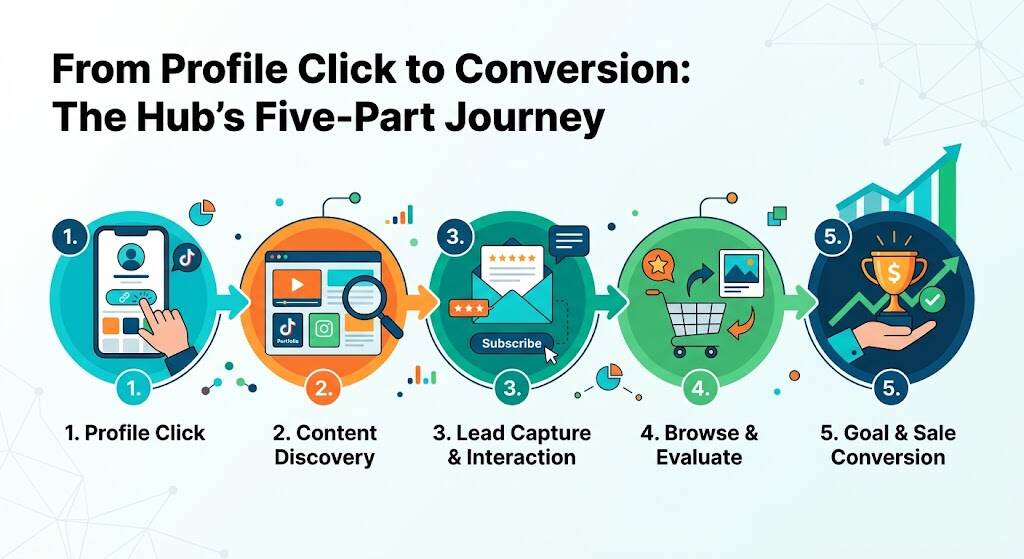
Select one objective. An artist may go for email sign-ups; a coffee shop may emphasize ordering online. Sticking to one main objective will make the link in bio tool relevant.
Organize the content blocks. Start with the key message first, followed by related links, contact information, and the chosen user-generated content.
Add media to the page. EmbedTree recommends that you include playable posts, videos, and widgets within the hub and not direct your visitors somewhere else.
Distribute the hub. If the embed works, host the hub on the website; otherwise, share the public URL across social profiles.
Evaluate the results. The guide mentions click-through analysis, heat maps, and UTMs. They tell you whether the social feed actually brings traffic, sign-ups, or sales.
Practical Examples: Small Pages With a Clear Job
Think about a bakery launching their weekend pre-order. The EmbedTree landing page can begin with “Pre-Order Saturday’s Box,” include an Instagram gallery of customers, and close with instructions. The use of user-generated content is social proof, but the single button ensures that the conversion element is not diluted.
In the case of a fitness coach, the landing page will have the initial consultation form, embed a YouTube video and finish off with TikTok tips. Here, it is essential that the social media aggregator plays its role according to the customer journey and not become a scrapbook.
The Trust Gap: What Our Reporting Could Not Confirm
The primary issue raised by EEAT relates to the fact that the site, even when it is active, seems to still be a very generic publication on games, technology, and social media. In the current review, it is clear that there were no visible signups, user dashboard, pricing page, technical information, and case studies of customers. There have been independent reviews in April and August 2026 indicating the same missing aspects.
Since there is no verified customer account of the current site, claiming happy customers is not based on anything. There have been some mentions of EmbedTree on a 2015 Product Hunt post; however, the relationship between the old one and the current site is unknown. Before linking accounts, ask for a demo, permissions, privacy terms, support promises, and customer references. Treat the social media content of EmbedTree as potentially promising software.
Also Read: Social Media Impact: How Social Platforms Benefit Society
How to Build a Better Hub, Whatever Tool You Use

Do not crowd the top screen with multiple actions. Keep the first view to a maximum of three options, compress the images, add the alt tags, and check all links going out from your site monthly. Assign each of your campaigns a UTM code. Measure the CTR, conversions, and page speed, not vanity metrics. A fast social media feed with good user-generated content will usually beat a cluttered wall.
Conclusion: One Link Is Useful; Trust That Can Be Verified Is Even Better
The most obvious lesson that we can learn from our analysis of the social media tools offered by EmbedTree is not that they are “magic growth tools” but rather that they are a good example of the hub approach with a partially revealed story behind them. The four-step workflow of curating, embedding, prioritizing, and measuring is indeed a good way for achieving more coherence in social media marketing. Still, companies should not trust any tools unless there is tangible evidence of their effectiveness.
