
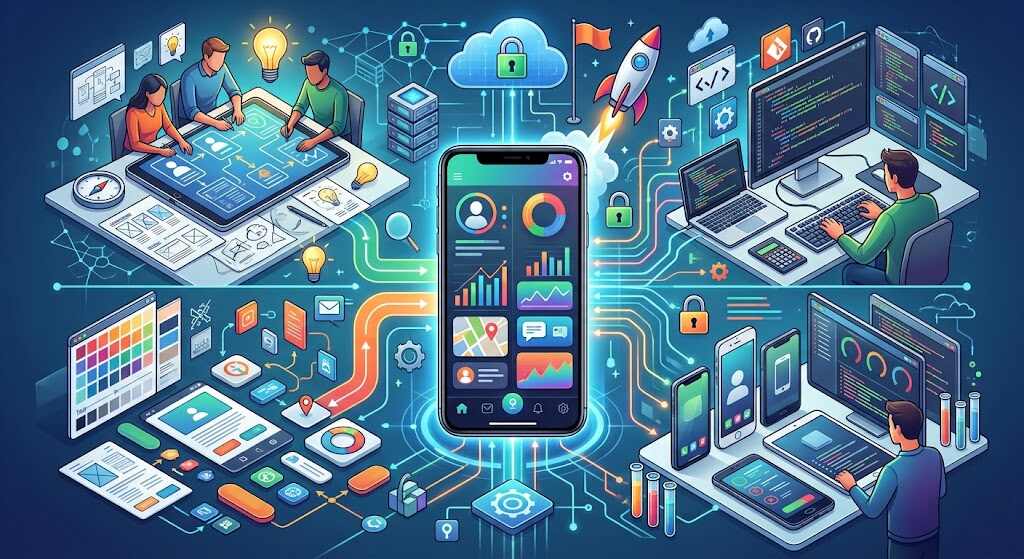
A successful mobile app is almost imperceptible to its users; they click, order, pay, book, or communicate and move on without any disruption. Designing this seamless experience is quite challenging. Mobile app development entails the conversion of the actual need of the users into reliable software on their devices. This involves product strategy, design of the interface, coding, testing, security measures, distribution in stores, analysis, and improvements. While coding is critical, the user’s time and trust, among other things, take priority.
What is Mobile App Development?
Fundamentally, an application consists of a front end that interacts with the underlying services. Front-end components interact with users in terms of taps, text input, graphics, accessibility issues, and navigation. Services deal with such issues as user accounts, payments, notifications, recommendations, and storage. Application Programming Interfaces facilitate the transfer of information between the interface of the application and its services.
In addition to the above issues, developing mobile applications implies working in two major ecosystems – iOS by Apple and Android by Google. Each platform has its own design principles, behavior of the devices, privacy statements, and reviewing policies. Apple positions its current review guidelines in terms of safety, performance, business issues, design, and legality. Similarly, Google promotes architectural solutions that ensure Android applications’ reliability, testing, and maintenance. Simply speaking, developing software for mobile devices means not only creating a small-scale website but designing personal devices that are equipped with sensors, may be interrupted, have bad connections, and run on batteries.
The Real Work Starts Before Coding
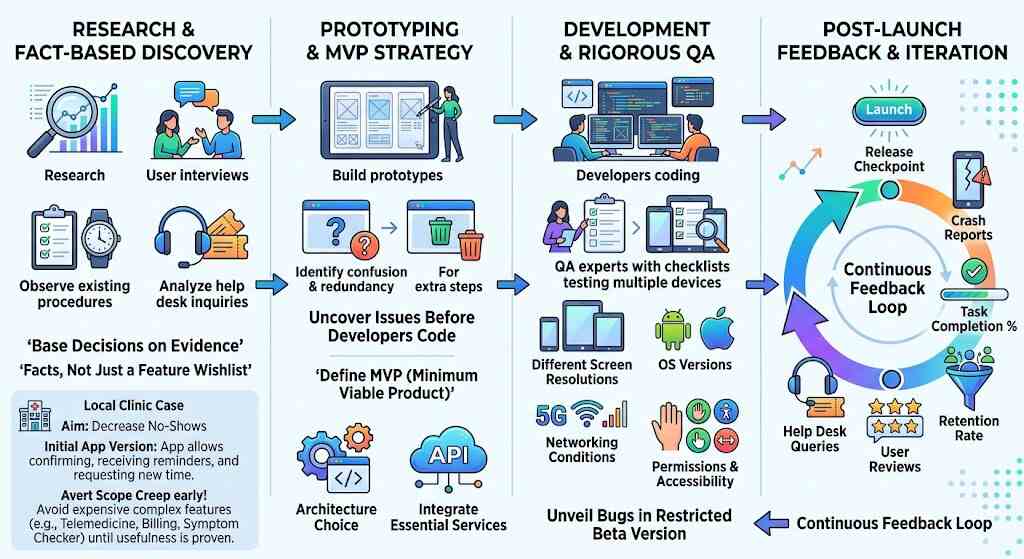
A well-grounded mobile application development is based on facts rather than an inventory of wanted features. It involves interviews with potential users, observation of existing procedures, analysis of help desk inquiries and choosing of one problem that should be fixed. In the case of a local clinic, the aim might be to decrease appointment no-shows. The first version of an app allows for confirming the appointment, receiving reminders and asking for another time. Implementing such functionalities as telemedicine, billing services and symptom checker before proving their usefulness will make the process more expensive.
Next step – building a prototype, i.e., screens which uncover any confusion or redundant actions before developers code them. After that, developers choose an architecture, incorporate services and develop an MVP. QA experts test apps in different screen resolutions, OS versions, networking conditions, permissions and accessibility options. A restricted beta version unveils bugs that were not found during laboratory testing. Release is just one of the checkpoints; feedback from crash reports, percentage of successfully performed tasks, retention rate, reviews and help desk queries helps to move to the next iteration.
Native, Cross-Platform, or a Mobile Web Experience?
Native apps utilize platform-specific tools like Swift for iOS and Kotlin for Android. They are ideal for apps that require high performance, heavy hardware interactions, or fine-tuned platform-specific behavior. Cross-platform frameworks bundle up a large chunk of the code, and there is little duplication; nevertheless, complex integrations sometimes require native knowledge. Progressive web apps function inside the browser and might be sufficient for occasional, data-driven activities.
It all comes down to user behavior and business risk, and not what the latest trend is. Native features might be justified if field technicians have to take photos offline in their day-to-day operations. In contrast, when a startup requires validating the booking process on both iOS and Android, a cross-platform app might be the way to go.
A Customer Lesson: Convenience Wins, Friction Loses
It is always most visible in action, not through lofty promises. In the third quarter of fiscal year 2026, Starbucks reported that 33% of its U.S. company-owned stores orders were made through mobile devices, alongside 35.8 million active Rewards members within the nation. They weren’t adopting “technology” in some abstract form; they were purchasing back time and controlling the process of pick-up.
It is also a warning sign. If an order ahead process delivers unattainable pick-up times, conceals customization, or leads to a crowded transfer, the app merely moves friction from the cash register to the smartphone screen. Properly executed mobile application development considers the complete process of service—both digital and physical, not just button tapping. The relevant question, when it comes to mobile applications for US companies, is not whether a mobile app is required, but which recurring customer pain point a phone will resolve better than any other medium.
Also Read: How AI App Builders Are Making Coding Obsolete
Trust Is a Product Feature, Not Fine Print
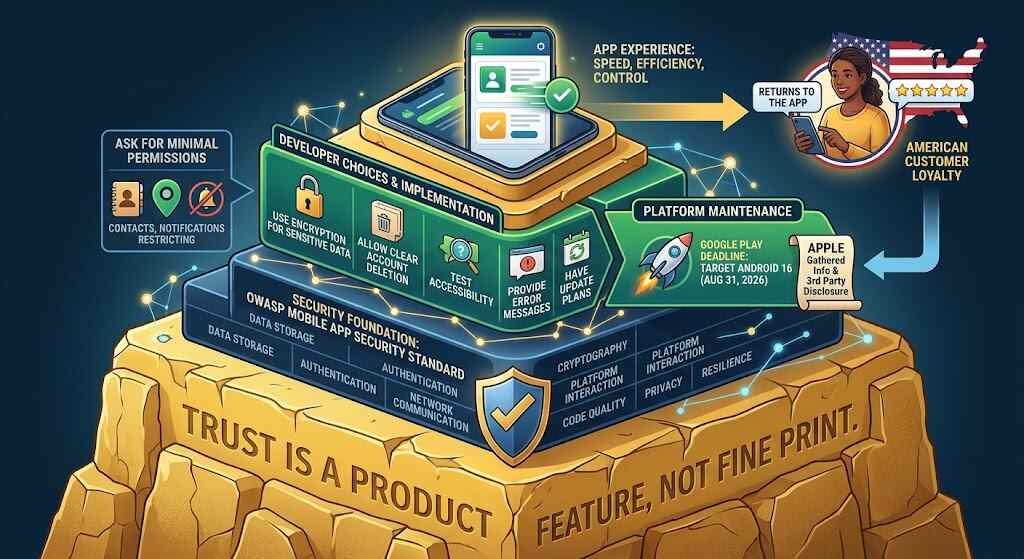
Speed, efficiency, and control matter. People also realize when an app requests access to contacts, location services, or notifications without any good reason for doing so. Apple demands from developers to disclose the information they gather as well as their third parties, and keep that information updated and up-to-date. The OWASP mobile application security standard includes data storage, cryptography, authentication, network communication, platform interaction, code quality, privacy, and resilience.
When speaking about the mobile application development team, it means making specific choices: ask for minimal permissions, use encryption for sensitive data, allow clear account deletion, test accessibility, provide error messages, and have update plans before releasing. Maintenance involves updating according to platform requirements; as of August 31, 2026, Google Play will demand to target Android 16 in new apps and app updates, with extensions available. Trust is not compliance. Trust is what makes an American customer come back.
Conclusion: Build the Useful Thing, Then Earn Loyalty
The process of developing a mobile application works best if the developers view the mobile device as a part of their lives and not just another vehicle to advertise new features. Identify the one source of irritation and then find the easiest path for the user. Ensure that user safety will be guaranteed and then watch their interaction with your application. The best application is not the one with the largest number of features but the one users can rely on.
FAQs About Mobile App Development
How long does it take to develop a mobile application?
It takes several months for an MVP to be completed, which depends on various things such as complexity of integrations, regulations, testing, and approval.
How much will the app cost?
The cost depends on the scope of development, platforms, integrations, design, security, and maintenance. It makes sense to estimate the smallest possible result first.
Is there a need for two apps: one for iOS and one for Android?
There isn’t always a need. The codebases are common in case of cross-platform development, while native development results in better performance, access to hardware and other platform-specific improvements.
What determines the success of mobile applications?
A good application should help users complete their tasks reliably. One should consider task completion rate, user retention, crash rate, amount of customer support calls and overall user satisfaction instead of downloading statistics.
What follows the product launch?
Following a product launch, bugs are fixed, feedback is collected, security is improved, device compatibility is checked and improvements are tested. Launching a product means starting its service lifecycle.
