

Search engine basics are the core processes search engines use to crawl, index, rank, and display pages for a query. If you understand search engine basics, you can build pages that are easier to discover, easier to interpret, and more likely to satisfy users because relevance, quality, and usability determine which results appear first and which pages stay invisible online.
- What Search Engine Basics Actually Cover
- Why Crawling Is Central to Search Engine Basics
- Indexing Decides Whether Content Can Compete
- Ranking Turns Search Engine Basics Into Visibility
- The Missed Insight: Retrievability Before Authority
- How to Apply Search Engine Basics on Real Pages
- Quick Technical Reference
- FAQs
What Search Engine Basics Actually Cover
At the practical level, search engine basics come down to four actions: crawling, indexing, ranking, and serving results. Most weak beginner guides overcomplicate this. Search engines first find pages, then process them, then compare them, then decide which page best answers a search.
That sequence matters because failure at any stage blocks the next one. A page that is not crawled cannot be indexed. A page that is not indexed cannot rank, no matter how good the writing looks.
| Stage | What happens | Common problem | What to fix |
|---|---|---|---|
| Crawling | Bots discover URLs through links, sitemaps, and known paths | Orphan pages, blocked resources | Improve internal links and XML sitemap |
| Indexing | Search engine stores and understands page content | Duplicate, thin, or noindex pages | Clean technical signals and strengthen page value |
| Ranking | Algorithms compare relevance and quality | Weak intent match, poor authority | Improve topical depth and on-page clarity |
| Serving | Search results are displayed for a query | Low CTR, weak snippets | Tighten titles, descriptions, and structure |
Why Crawling Is Central to Search Engine Basics
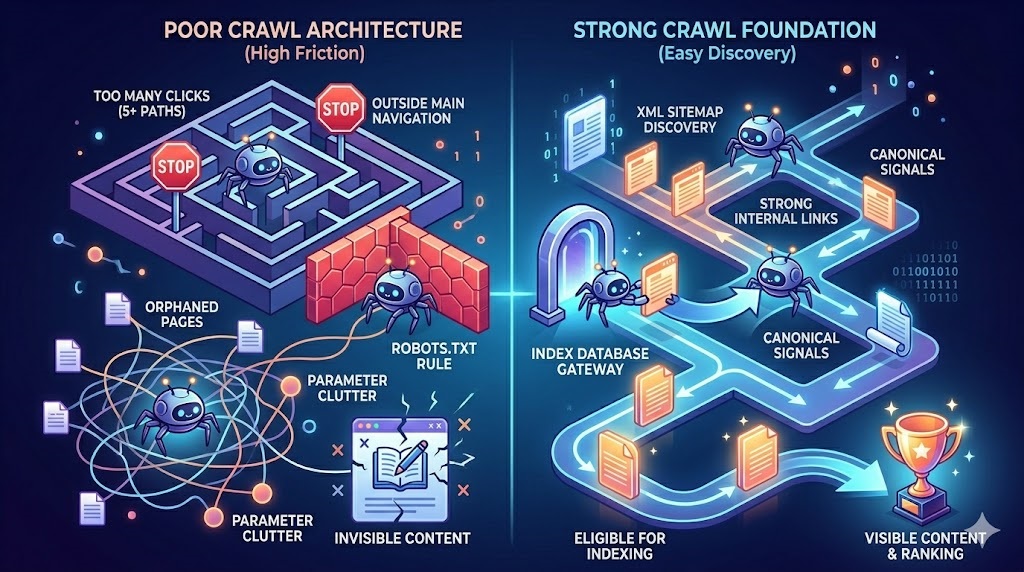
A search engine does not discover your site by magic. In search engine basics, crawling starts with links, sitemaps, canonical signals, and server accessibility. If your important page takes five clicks to reach, sits outside the main navigation, or is blocked by robots rules, you are making discovery harder than it should be.
This is where many sites lose visibility before rankings are even relevant. In real estate and technical niches, large site structures often create orphaned pages, parameter clutter, and duplicated archives. Strong search engine basics begin with architecture, not copywriting.
Indexing Decides Whether Content Can Compete
Indexing is where Google interprets the page and decides whether it deserves a place in the searchable set. Good search engine basics require clear HTML structure, crawlable text, useful main content, and a page that is distinct from other URLs on the site.
If ten pages say nearly the same thing, search engines may ignore most of them. If the primary content is hidden behind scripts, weak rendering, or messy templates, the page can be discovered but still fail to become useful in the index. That distinction is central to search engine basics, and most beginner articles barely explain it.
Ranking Turns Search Engine Basics Into Visibility

Once a page is indexed, ranking begins. Here, search engine basics are not about “tricks.” They are about intent match, topical completeness, internal linking, authority signals, freshness when relevant, and page experience.
For a query like search engine basics, the dominant intent is informational and beginner-focused. Users want a clear explanation, plain language, trustworthy examples, and a fast path from concept to action. If your article reads like a glossary entry, it will feel incomplete. If it reads like a sales page, it will miss the query entirely.
The Missed Insight: Retrievability Before Authority
Here is the point many competing pages miss: the real bottleneck is often retrievability, not authority. People assume content fails because it lacks backlinks. In many cases, it fails because search engines cannot reliably access, render, consolidate, or interpret the page in the first place.
That is the information gap within many guides on search engine basics. Beginners are told to “create quality content,” but not told that technical clarity is what gives that content a fair chance to be evaluated. A page must become eligible before it can become competitive.
How to Apply Search Engine Basics on Real Pages
If you want search engine basics to improve traffic, apply them in a strict order. First, confirm the page can be found. Second, confirm it can be indexed correctly. Third, align the page with the user’s query. Fourth, strengthen supporting signals around it.
For one page targeting search engine basics, that means using a direct title, clear headings, definitions in plain language, and internal links to related topics such as crawling, indexing, ranking factors, XML sitemaps, robots.txt, canonical tags, search intent, SERP features, structured data, page experience, backlinks, E-E-A-T, Google Search Console, Core Web Vitals, and internal linking. Those entities help establish topical authority without bloating the article.
A solid page also avoids predictable mistakes. Do not stuff search engine basics into every line. Use the phrase naturally in the title, introduction, subheads, key transitions, and FAQ sections. The goal is semantic reinforcement, not repetition for its own sake.
Also Read: Web WhatsApp for Phone: Setup, Login and Safety Tips 2026
Quick Technical Reference
Discover URL → Crawl page → Render content → Evaluate quality→ Index eligible version → Match query intent → Rank against competitors→ Serve result → Measure engagement signalsThat sequence is the operating model behind search engine basics. If performance breaks early, later optimization has limited effect.
FAQs
What are search engine basics?
Search engine basics are the core steps search engines use to find, store, evaluate, and show web pages. The four pillars are crawling, indexing, ranking, and serving.
Why is indexing different from crawling?
Crawling means a bot found the page. Indexing means the page was processed and added to the searchable database, which is a much higher bar in search engine basics.
Do backlinks matter in search engine basics?
Yes, but not first. In search engine basics, technical access and intent alignment usually matter before link authority can help.
How do I improve a page about search engine basics?
Tighten site structure, clarify headings, remove duplication, improve internal links, and answer the query directly. Better usability often improves search engine basics performance faster than superficial keyword edits.
Search engine basics are not theoretical. They shape whether your page is discovered, understood, trusted, and shown to the right searcher. Learn the sequence: crawl, index, rank, satisfy. When you build content around user intent, clean site architecture, and clear topical signals, search engine basics stop being jargon and start becoming a measurable growth advantage for any site you publish.
