
A software demo looks convincing when every order moves smoothly. Real distribution operations are messier: customers change quantities, invoices stall, inventory sits in the wrong bin, and payment systems fail at inconvenient moments. That is why someone typing “give me customer stories for cavallo.com” usually wants more than marketing promises.
Here are five additional Cavallo customer accounts, with reported outcomes, limitations, and lessons for buyers.
Which Cavallo Customers Faced Problems Like Yours?
Cavallo’s distribution tools include SalesPad, which extends supported ERP workflows. Choose a customer example that resembles your bottleneck, not merely one with impressive numbers.
| Customer | Challenge | What Cavallo’s case study reports |
|---|---|---|
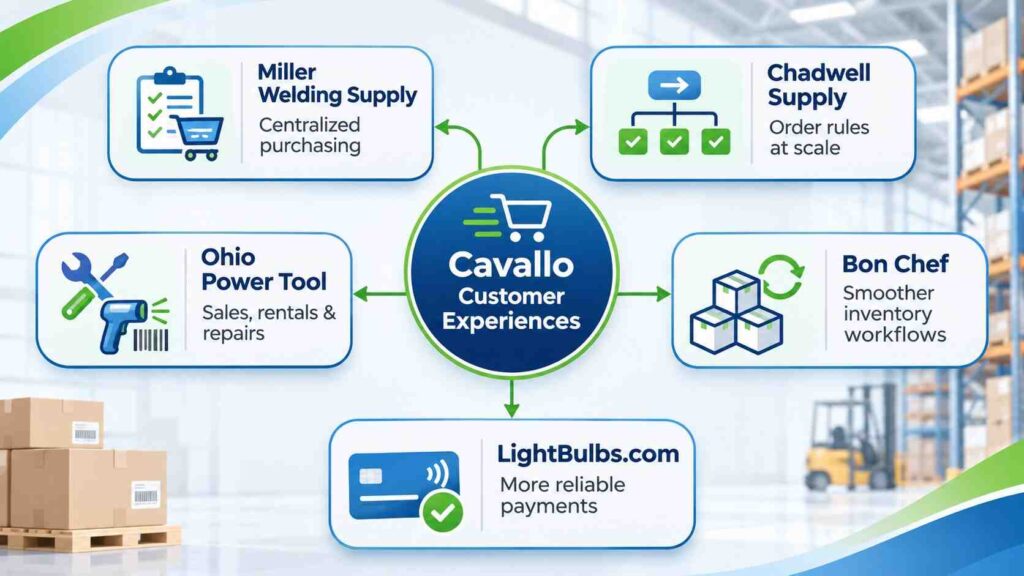
| Miller Welding Supply | Fragmented purchasing across branches | Purchasing consolidated to one person working about three hours daily |
| Chadwell Supply | Complex order rules at high volume | Workflows supporting a business handling nearly 5,000 daily orders |
| Ohio Power Tool | Rental, repair, and sales processes | Easier customer lookup and barcode-based warehouse tracking |
| Bon Chef | Unreliable stock records and rigid systems | Faster order entry and less manual inventory reconciliation |
| LightBulbs.com | Card-processing interruptions | No payment downtime reported after its SalesPad–Square integration |
These company-published accounts cover different products and periods; they are not independent performance tests.
Five Cavallo Customer Experiences Behind the Headlines
Miller Welding Supply: Fixing the Purchasing Bottleneck
Industrial distributor Miller Welding Supply struggled to coordinate purchasing across branches.
Cavallo’s Miller Welding case study says the business centralized purchasing after adopting SalesPad. Work that had involved three employees became a task one person handled in about three hours daily.
President Michael Clay discussed an estimated $250,000 value, not a documented annual cash saving.
Useful takeaway: Centralized purchasing can remove duplicate work and improve inventory forecasting. A potential buyer should ask how the Cavallo workflow handles branch-specific needs, urgent replenishment, and staff absences.
Chadwell Supply: Applying Business Rules to Complex Orders
Chadwell Supply distributes maintenance products for properties, from small repairs to large renovations.
In Chadwell’s published story, the company describes handling close to 5,000 sales orders daily. Cavallo SalesPad helped staff route orders according to business rules, examine account histories, and plan inventory from project requirements.
One example is a rule that directs orders from customers more than 60 days overdue into account review. It reduces reliance on an employee noticing the problem manually.
Automated account controls can also help distributors manage overdue payments without relying entirely on manual checks. This related guide to automating collections workflows explains how businesses can use ERP data, overdue-invoice tracking, and rule-based processes to manage outstanding accounts.
Useful takeaway: Order processing automation is about consistency, not just speed. Still, the Cavallo case study does not establish that all 5,000 orders resulted from the software, nor does it quantify the financial effect of the credit-control rule.
Ohio Power Tool: Joining Sales, Rentals, and Repairs
Ohio Power Tool sells, rents, and services tools. Each transaction type demands different documentation and follow-up. Separate applications complicated customer service.
The Ohio Power Tool account describes Cavallo SalesPad helping employees retrieve customer histories, returns, and open orders. Adding Inventory Manager brought barcode scanning and multi-bin locations into warehouse inventory management.
For a busy team, that means identifying the correct stock and associated order without searching shelves by memory alone.
Useful takeaway: ERP integration should reflect real work. The study gives no verified percentage reduction in errors or handling costs.
Bon Chef: Keeping Existing Processes While Updating Systems
Bon Chef supplies food-service equipment. Its older ERP environment struggled with reliability, inventory synchronization, and a warehouse setup that depended on established assembly processes.
According to the Bon Chef case study, Cavallo SalesPad and Microsoft Dynamics GP were configured with an implementation partner to fit the company’s existing operations. Order entry became easier, automated document emails saved time, and inventory records required fewer exceptional synchronizations.
Cavallo adapted to Bon Chef’s established workflows.
Useful takeaway: Ask how much configuration was needed. Customizing a sales order workflow can preserve useful practices, but development, testing, and ongoing maintenance belong in the total cost of ownership.
LightBulbs.com: Treating Checkout Reliability as a Sales Issue
A distributor cannot complete an order if its payment gateway becomes unavailable. LightBulbs.com had experienced interruptions with a previous provider while processing more than $10 million in card transactions annually.
Its Cavallo customer story describes integrating SalesPad with Square for card payments. The company reported zero downtime after deployment and easier handling of online transactions within its sales workflows.
Zero reported downtime during an unspecified period does not guarantee future uptime.
Useful takeaway: Assess payment reliability, support response, reconciliation, and credit card processing fees together. Operational stability has value, but Cavallo’s published account does not provide a calculated profit increase.
What Can You Conclude From These Cavallo Stories?

A useful case study explains the original problem, the change, and how success was measured.
Miller Welding offers an approximate labor comparison and a customer-estimated value. Chadwell describes business-rule controls at scale. Ohio Power Tool and Bon Chef explain workflows without publishing a controlled financial comparison. LightBulbs.com reports availability, but not a service-level audit.
This matters when evaluating profit margin optimization. Time saved is only a monetary saving if it reduces expenses or frees capacity that produces useful revenue. Fewer stock errors may reduce returns, but your company still needs a baseline.
For example, saving 12 staff hours each week at a loaded labor cost of $30 per hour represents $18,720 in annual capacity across 52 weeks. That is not automatically $18,720 in reduced payroll. Cavallo deployment and support costs must also be considered.
How to Judge Whether Cavallo Fits Your Business
Rather than copying another distributor’s goals, build a short purchasing test:
- Choose one workflow. Identify a recurring failure in B2B order management, stock visibility, or purchasing.
- Record current performance. Track errors, processing time, and costs for several weeks.
- Check the exact integration. Confirm the Cavallo product supports your ERP version, payment services, and warehouse tools.
- Request a realistic demonstration. Bring anonymized cases that include returns, partial shipments, or account holds.
- Calculate the full expense. Include setup, licensing, staff training, and maintenance.
- Ask for a reference. Speak with a Cavallo customer whose order volume and operations resemble yours.
Internal-link opportunity: A related guide on Microsoft Dynamics GP, inventory forecasting, or distribution management software would fit after this checklist, provided it answers a genuine follow-up question.
For readers searching “give me customer stories for cavallo.com”, compare the original studies with your needs. Older SalesPad results do not describe every current Cavallo product.
Frequently Asked Questions
Are these Cavallo stories real customer experiences?
Yes. Cavallo identifies named organizations and describes their software projects on official case-study pages. The reported statements and figures have not been independently audited here.
Does Cavallo work only with Microsoft Dynamics?
Different Cavallo products have different integration requirements. Many SalesPad customer stories involve Dynamics GP, while other current offerings have separate compatibility requirements. Confirm the specific product before committing.
Can Cavallo increase profit margins?
Better purchasing, pricing controls, and fewer errors may help, but the five experiences above mostly document workflow improvements. They do not establish a universal margin lift.
Where should I start evaluating Cavallo?
Begin with your costliest repeatable process, request a demonstration using representative data, and measure the outcome against a baseline. Ask Cavallo for a current, comparable customer reference.
Conclusion
These five Cavallo accounts tell a more varied story than a single growth statistic. Miller Welding improved purchasing coordination; Chadwell applied order rules; Ohio Power Tool connected different transaction types; Bon Chef protected existing operations; and LightBulbs.com addressed payment reliability.
Read the primary sources, identify comparable challenges, and ask what costs or trade-offs the summaries omit.
