

While dropshipping may appear easy on the surface, it doesn’t take long before the actual number of orders puts pressure on the system. A store can operate with just a few checks carried out manually every day, yet it will not be able to scale with spreadsheets, supplier assumptions, and reactive customer service. This is where the need for AI dropshipping arises.
The real value of AI dropshipping doesn’t lie in automated processes that increase efficiency. The real value of AI dropshipping lies in the ability to integrate catalog management, supplier strategy, pricing updates, orders, and customer service into one coherent process. This integration is what makes an ecommerce business stable and scalable.
- What is AI AI Dropshipping?
- Why AI Dropshipping integration matters
- What an automated workflow actually looks like
- Practical examples from real technical store patterns
- Where stores still get AI Dropshipping wrong
- Conclusion
- FAQs
- What exactly can be automated with the help of AI Dropshipping?
- Does AI Dropshipping require advanced stores only?
- What inventory management improvements can be made using AI Dropshipping?
- Why is Shopify automation needed for AI Dropshipping?
- Can AI Dropshipping help with reducing number of support tickets?
What is AI AI Dropshipping?
AI Dropshipping uses AI technology, automation of workflows, and live data from a store to perform key dropshipping functions through less manual input and better decision-making processes. Instead of being rule-based only, AI Dropshipping is able to analyze supplier feeds, detect any changes in the inventory, set priorities for shipping, optimize product listings, and launch customer communication in real-time.
In essence, AI Dropshipping finds itself at the intersection of ecommerce automation, inventory management, order fulfillment, and customer support automation. This allows stores to interpret operational signals in real time. This implies that inventory changes will be detected quicker, shipping disruptions will be reported faster, and pricing algorithms will be able to react to cost changes prior to having an impact on margins.
Why AI Dropshipping integration matters
Many shops employ various tools, but without integration between them, they will not deliver smart and seamless processes. Imports are processed using one app, order management is done using another, e-mail is handled using yet another application, and there’s one more application for monitoring support. As a result, merchants still have to handle issues manually. That’s why AI Dropshipping becomes significant – it integrates all these tools.
Integration with AI Dropshipping generally includes three technical levels:
- Intelligence for catalog cleaning and product listing standardization
- Pricing, stock and supplier routing logic
- Event driven automation for fulfillment and support tasks
That is why the high-growth sellers are leaning towards Shopify automation, product research, and operational triggers. In the case of actual businesses, there are not just bottlenecks in traffic but in the entire flow process.
What an automated workflow actually looks like
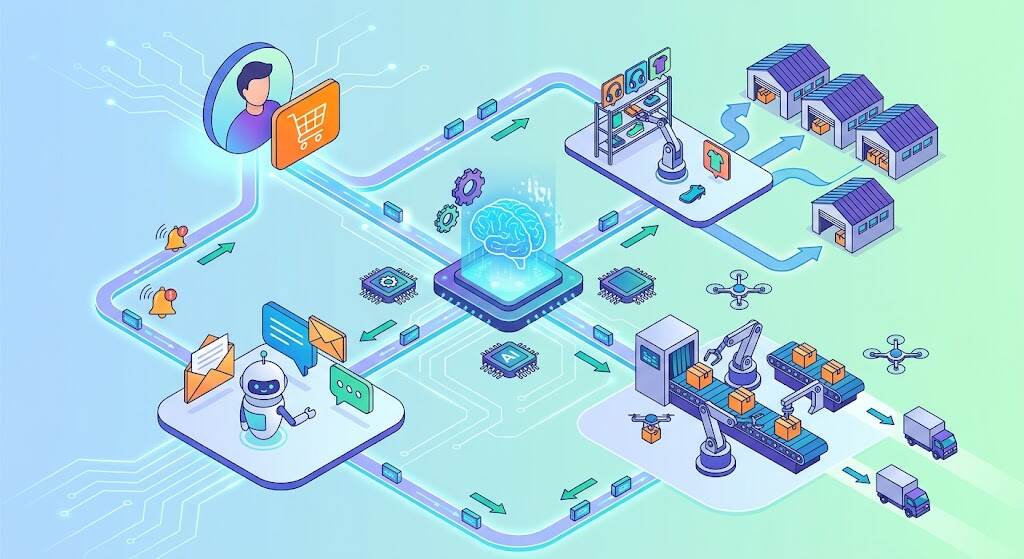
An efficient AI Dropshipping process begins long before the product goes live. Supplier feeds will typically have duplicate products, mismatching variants, inconsistent names, and lack of necessary information. The use of AI-powered reasoning can help bring the data in harmony, translate the features into the format of catalog parameters, and mark products that are likely to be returned. The product selection will become more relevant because the store takes into account its reliability, and not only trendiness.
Once the customer completes the purchase, the second phase of the AI-powered dropshipping kicks in. Order fulfillment is where the process gets really smart. Instead of simply sending the order to the main supplier, the system checks for product availability, the region of the warehouse, delay ratio and defectiveness history. Smart order routing guarantees good delivery performance while maximizing profits at the same time.
Finally, once the order is sent out, AI Dropshipping process continues to operate in the background. Shipping tracking events can activate automatic service actions, such as delay alert, adding order tags for internal investigation, and suggesting replacements or refund options. It is real customer service automation, and not some automated chatbot behavior.
Also Read: Gramhir.pro AI Image Generator: Your Fast & Free Art Maker
Practical examples from real technical store patterns
Another issue that comes up frequently in AI Dropshipping businesses is non-conformant variant mapping. The same bed sheet size was referred to as “Queen,” “QN,” and “150×200” on the website for home-textiles that had several suppliers. The order was processed correctly but the fulfillment process was incorrect because of it. The problem was solved by setting up AI Dropshipping rules for normalization of the variant values and blocking the catalog syncing in case it was incomplete. It was obvious that such an issue could be solved thanks to inventory management and ecommerce automation.
As the second example, there was a story about the management of margins. The store selling beauty accessories used automation on Shopify and linked supplier cost changes to advertising expenses and refund rate signals. The AI Dropshipping process changed the price of a product only when the risk of margin reduction exceeded the necessary threshold, which helped not to underprice profitable items during spikes of the campaign and to protect cash flows from unexpected increases in shipment costs.
It is important to mention another advantage of AI Dropshipping technology regarding customer support processes. Customers’ problems are not caused mostly by delays; they occur due to lack of communication. The AI Dropshipping process is capable of reading carrier events and estimating the probability of the delay and sending personalized notifications before customers ask about the order. Such an approach helps to reduce the number of WISMO tickets as it uses customer service automation based on fulfillment data.
Where stores still get AI Dropshipping wrong
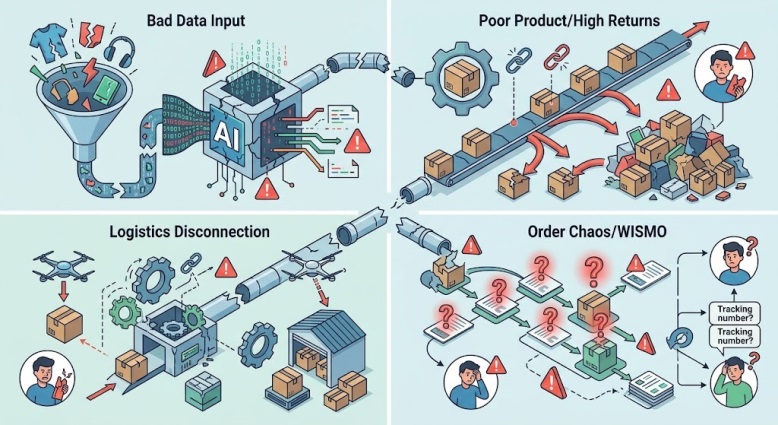
First, misunderstanding of what true integration looks like. It’s not about using sourcing tools, tracking tools, AI writing tools. The store might do all that and still experience poor operations. And AI Dropshipping works only in case the data is organized and interchanged.
Secondly, lack of attention to the problem of exceptions. A strong AI Dropshipping solution must be failure-resistant: stock drifts, splits shipments, late scans, damaged goods, substitutions of the supplier, warehouse backup solution – all that should be managed.
Thirdly, insufficient measuring. Merchant must measure his AI Dropshipping through such metrics as cancellation rate, gross margin, fulfillment accuracy, first response time, delivery SLA performance. Otherwise, automation will become just a feature list.
Conclusion
The AI Dropshipping model that works best is far from a no-man’s business. Rather, it is a technical system that is strong enough to deal with complexity and not break down under pressure. By incorporating clean data, reliable inventory systems, responsive automation of Shopify, better order fulfillment automation, and trigger-driven automation of customer services, AI Dropshipping becomes an actual business framework. And here lies its value – reduced risks of operational errors, improved margins, increased trust of buyers, and scalable workflows.
FAQs
What exactly can be automated with the help of AI Dropshipping?
AI Dropshipping can automate cleaning of product data, price adjustment, supplier selection, stock monitoring, order fulfillment update, and support ticket response related to order-related events.
Does AI Dropshipping require advanced stores only?
No. Small businesses may find themselves in advantage, because ecommerce automation will help to avoid manual fixes and keep consistency in order processing while scaling their business.
What inventory management improvements can be made using AI Dropshipping?
Improved inventory management will come from fast synchronization of stock available from suppliers and detection of inconsistencies, along with avoidance of overselling due to automated availability checks.
Why is Shopify automation needed for AI Dropshipping?
Shopify automation is needed because most of the dropshipping stores use Shopify API and connected apps to process orders, products and customers information.
Can AI Dropshipping help with reducing number of support tickets?
Yes. With AI Dropshipping connected to tracking events and order risk factors, customer support automation becomes possible.
