

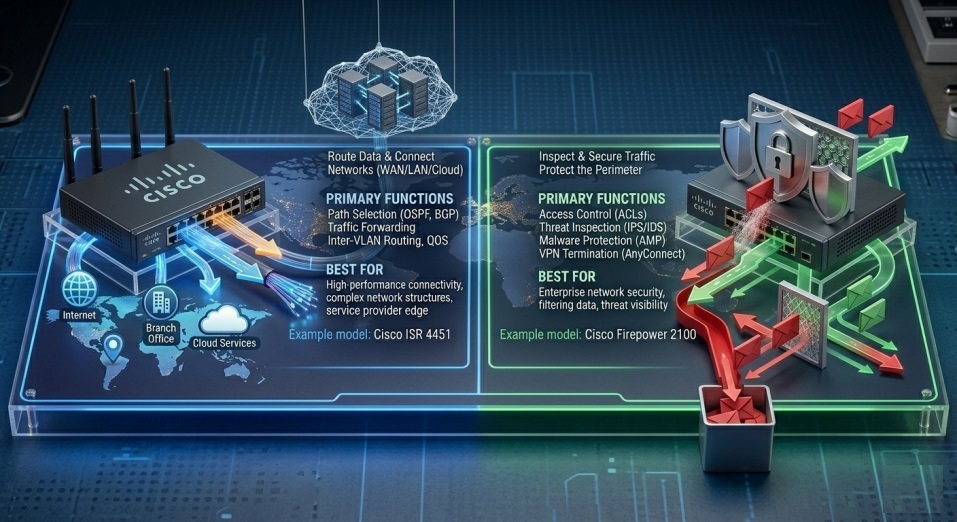
For brands planning a robust hardware and networking setup, there are many queries and doubts. Many of them experience uncertain whether or not they need a firewall when the router is already in place, whether or not it will improve network safety, or whether or not they can do without. However, the solution isn’t always that simple.
Whether you need a Cisco router or a firewall depends on some key factors. You need to think about how much traffic you’re handling and what you’re trying to protect.
- What does a router do?
A router’s main job is to move traffic between networks. It scans the destination of a packet and decides the best path to send it. Cisco routers are designed for this job. They are good for managing WAN connections and routing traffic between your internal subnets. They are also suitable for link failover and VPN tunnels.
The latest Cisco routers come with advanced security features, including zone-based firewalls and access control lists. With such functions you can block ports, limit sources and set up simple traffic filtering. So, a router can handle some firewall work.
- The working mechanism of a firewall
A dedicated firewall, such as the Cisco secure firewall, offers advanced security features. A router looks at where traffic is going, but a firewall can analyze that traffic.
It may be used to perceive and block threats and malware in actual time. You can use it to implement user, software, and URL-based get right of entry to rules. The tool can even generate visibility logs for security review needs.
A firewall also provides dedicated processing hardware for in-depth network traffic inspection.
- Why does it get confusing?
The lines between Cisco firewalls and routers are getting blurred. Cisco’s routing platforms now include security features. Similarly, the company’s Secure Firewall can handle routing, NAT, and VPN termination. In the past, these needed a separate router.
- When do you need a router?
There are real scenarios where a router without a dedicated firewall can do well. For example, internal routing between VLANs doesn’t necessarily require dedicated firewall inspection.
Also, small branch offices with minimal internet exposure and a managed security service can do without a firewall.
- When do you need a dedicated firewall?
When your business handles large amounts of customer data and Internet traffic, it benefits from a firewall. This is more true for companies that must follow protocols such as HIPAA and ISO 27001.
However most medium-sized businesses and enterprises use both routers and firewalls.
For them, the router manages the physical connection to the Internet or the MPLS network, and handles the routing protocol. The firewall checks everything that crosses the perimeter and applies application-layer policy to reduce threat factors.
Summing it up
If you have a startup with low-risk exposure and a small network, a router with basic security features can fit the bill. However, brands dealing with growing customer data and security needs can’t rely solely on a router. A dedicated firewall is more than an add-on for them, especially when there is a compliance requirement on the scene. Cisco’s portfolio covers both ends well.
