


Nanotechnology is a technology of designing matter based on a scale that is so tiny that we possess familiar materials, which begin to behave in new ways. It is that change which makes nanotechnology effective in medicine, electronics, energy, filtration and high-tech manufacturing.
The word nanotechnology has two primary initial impressions with the vast majority being either a textbook definition or a sensational headline. Nor does either give the whole story. Nanotechnology, in the real world, is not a spectacle but control – control of behavior of a substance, control of the functionality of a device and the degree to which something can be made precise.
This is the reason why the field has remained relevant. It is not a trend word. It is an actual industrial science and engineering of value.
- What is Nanotechnology?
- Why the Nanoscale Changes Material Behavior
- A Simple Example: Same Material, Different Result
- How Nanotechnology Works
- The Tools That Make Nanotechnology Possible
- Where Nanotechnology Is Used Today
- Comparison Table: Bulk Materials vs Nanoscale Engineering
- Why Nanotechnology Matters
- Better Results With Less Material
- The Limits of Nanotechnology
- Safety, Risk, and Regulation
- What Competitors Usually Miss
- The Future of Nanotechnology
- Final Take
What is Nanotechnology?
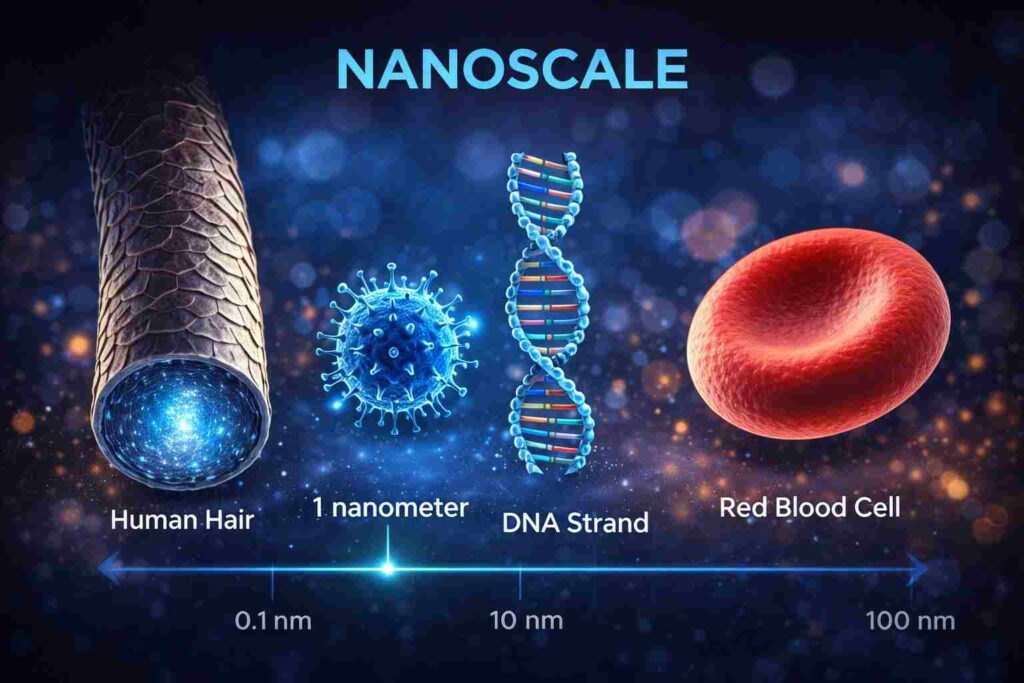
The common definition states that nanotechnology is concerned with structures of 1 to 100 nanometers. That is true, although in itself it is not very helpful.
Function is a better starting point. At that scale the physical rules governing bulk materials are not necessarily the entire story. The same chemical can remain the same chemical and yet act differently when the material is engineered at the nanoscale. It is there that nanotechnology takes its advantage.
So the real meaning of nanotechnology is not “very small technology.” It is the intentional design of matter at a size where performance can change in useful ways. Engineers are not shrinking things just to prove they can. They are trying to get different results—better conductivity, more precise delivery, higher strength, improved sensitivity, or a more efficient reaction.
Why the Nanoscale Changes Material Behavior
Size is not a cosmetic detail in nanotechnology. It is the reason the field exists. At the nanoscale (matter has been whittled down to the nanoscale), a larger fraction of atoms resides on the surface rather than being buried in the structure. That alters the interaction of a material with the environment. Light, heat, moisture, electrical charge, other chemicals, even living tissue—these interactions can all shift once the material is built small enough.
The second is what occurs to electrons at very small sizes. The change in the behavior of electrons in certain situations is sufficient to produce an effect on the way a material conducts electricity, absorbs light, and/or magnetically responds. That is one reason nanotechnology matters in semiconductors, sensors, and imaging systems.
None of this is abstract once you see the pattern. Nanotechnology matters because the nanoscale is often the point where materials stop behaving in ordinary ways and start becoming more useful.
Surface Area Changes Everything
The surface area is like a dry classroom concept before you relate it to what engineers are really interested in. A large chunk of the same material contains a lot more of its mass than a nanoscale particle, and therefore has a much lower ratio of surface to volume. That provides reactions and interactions with additional space.
This is one reason nanotechnology shows up in catalysts, filters, coatings, diagnostics, and energy systems. If performance depends on what happens at the surface, then increasing usable surface area can change the outcome. Sometimes that means faster reactions. Sometimes it means better absorption. Sometimes it means a sensor can detect smaller traces of a substance.
In plain terms, nanotechnology makes some materials more active without changing what they are made of. The change comes from structure, not branding.
Quantum Effects Matter at Very Small Scales
There is no need to drown this topic in theory. The practical point is enough: at very small scales, materials can display behavior that does not show up the same way in bulk form.
That matters because nanotechnology is often built around those differences. A nanoscale material may handle light differently, conduct electricity differently, or respond to fields and forces in ways that create new engineering options. This is where the field becomes especially important in electronics, optics, and sensing.
The phrase quantum effects can scare off general readers. It should not. For most users, the important takeaway is simple: small scale can produce different material behavior, and nanotechnology is the discipline that turns that fact into something practical.
A Simple Example: Same Material, Different Result
Gold is useful here because people think they already know what gold is. In bulk form, it is stable, familiar, and visually predictable.
At the nanoscale, that changes. Gold particles can interact with light differently and become useful in diagnostics, imaging, and sensing. The material has not stopped being gold. What changed is the scale at which it was engineered.
That is a better way to understand nanotechnology than any dramatic metaphor. The field often works by taking a known material and reorganizing it so that its useful properties become more pronounced—or entirely different—at a much smaller size.
How Nanotechnology Works
When it comes to making things using nanotechnology, there isn’t just one way to do it. Instead, the work can go in one of two main directions: either by using top-down methods or bottom-up methods.
The top-down route starts large and cuts downward. The bottom-up route starts small and builds upward. Both matter. Both are already part of real engineering practice.
What really matters is not what we name it, but how it actually works. When we’re talking about nanotechnology, we’re basically talking about being able to control the tiny things that make up everything around us, and we need to be precise about it. It doesn’t really matter if we’re cutting, adding, putting together, or growing these tiny things – the goal is always the same. We want to make things that work better just because they’re made up of tiny parts that are put together in a special way.
By working with things that are really, really small, we can make things that are stronger, or faster, or that use less energy, and that’s what nanotechnology is all about.It’s like building with tiny blocks, but instead of blocks, we’re using tiny particles that are too small to see. And when we get it right, we can make some really amazing things.
Top-Down Nanotechnology
Top-down nanotechnology begins with a larger piece of material and reduces it into smaller structures through methods such as etching, patterning, or precision fabrication. This is familiar territory in electronics and semiconductor manufacturing.
The strength of this approach is control. Engineers can define shapes and structures with high accuracy, which is one reason top-down methods are closely tied to integrated circuits and other high-precision systems.
When people talk about smaller, denser, faster electronics, nanotechnology is often part of the process behind those improvements. The finished product may never advertise that fact, but the engineering is still there.
Bottom-Up Nanotechnology
Bottom-up nanotechnology works the other way around. Instead of cutting a structure down from something bigger, scientists assemble it from atoms, molecules, or nanoscale building blocks.
This approach is powerful because it can produce arrangements that would be extremely difficult to machine by force. Chemistry, biology, and materials science all make use of bottom-up thinking. That is part of why nanotechnology has such a strong connection to drug delivery, smart materials, molecular design, and self-assembly.
If top-down methods feel like sculpting, bottom-up methods feel closer to construction. Both belong in the field. The best choice depends on the material, the application, and the level of control required.
The Tools That Make Nanotechnology Possible
Without the right tools, nanotechnology would remain mostly theoretical. You cannot engineer what you cannot observe, and you cannot validate what you cannot measure. That is why instruments such as electron microscopes, atomic force microscopes, and related nanoscale imaging systems matter so much. They allow scientists to examine surfaces, identify structures, test behavior, and confirm whether a design is doing what it is supposed to do.
These tools changed the field from an idea into a workable discipline. They gave researchers a way to see the nanoscale rather than simply describe it. In any serious discussion of nanotechnology, that shift is foundational.
Where Nanotechnology Is Used Today
This is where the field becomes easier to respect. Nanotechnology is already present in enough real applications that it no longer makes sense to describe it as a distant possibility.
It is also where sloppy writing usually starts. Some articles rattle off use cases without helping the reader understand which ones matter and why. A better approach is to focus on the sectors where nanoscale engineering changes actual performance.
That is the right lens for nanotechnology: not novelty, but measurable gain.
Nanotechnology in Medicine
Medicine rewards precision, which is exactly why nanotechnology keeps finding a place there. Researchers are interested in ways to move treatments more accurately, improve imaging, and detect disease signals earlier or more clearly.
In some medical applications, nanoscale carriers can help deliver a compound more selectively than conventional methods. In others, nanoscale materials improve how scans, tests, or diagnostic tools perform. The point is not that nanotechnology fixes medicine by itself. The point is that it offers more control, and better control often leads to better outcomes.
This is one of the clearest examples of why nanotechnology matters. In healthcare, small improvements are not small at all.
Nanotechnology in Electronics
Electronics has pushed toward smaller, faster, and more efficient systems for decades. Nanotechnology fits that trajectory naturally.
At the nanoscale, engineers can create components that support higher performance in less space. That matters in semiconductors, sensors, memory systems, conductive materials, and heat management. Some of the gains users notice—speed, responsiveness, lower energy draw, better device performance—depend on work happening at dimensions too small to see.
That is an important point. Nanotechnology is already part of ordinary consumer and industrial electronics, even when the product description never uses the word.
Nanotechnology in Energy
Energy systems are shaped by efficiency limits, material limits, and cost pressure. That makes them a natural testing ground for nanotechnology.
Nanoscale engineering can improve how battery materials store charge, how catalysts support reactions, how membranes filter substances, and how energy materials interact with light or heat. These are not cosmetic improvements. In energy, even modest performance gains can matter at scale.
That is why nanotechnology keeps appearing in work on batteries, solar materials, hydrogen-related systems, and industrial filtration. The field is useful where material behavior controls the result.
Nanotechnology in Materials and Manufacturing
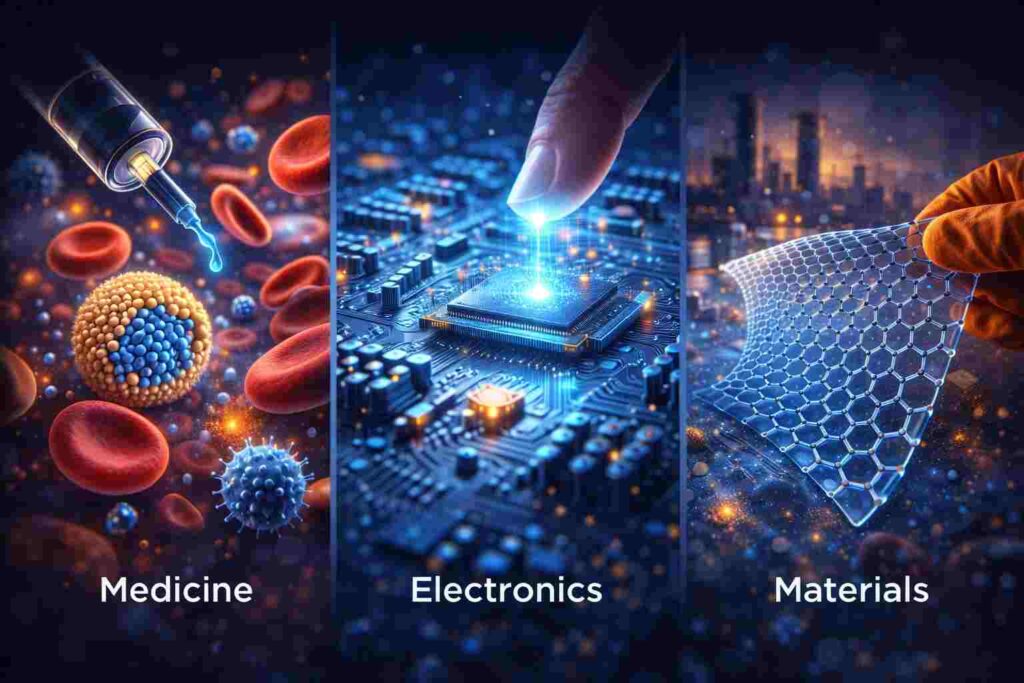
This may be the least glamorous part of the story, but it is often the most commercial. Nanotechnology can make coatings harder, surfaces cleaner, materials lighter, and composites tougher.
A manufacturer does not need a flashy label to value that. If a product resists corrosion longer, scratches less easily, or performs better under stress, that has obvious market value. The same logic applies to packaging, construction materials, industrial equipment, textiles, and specialized surfaces.
This is why nanotechnology is not just a research topic. It is a materials strategy.
Comparison Table: Bulk Materials vs Nanoscale Engineering
| Feature | Bulk Material | Nanoscale Material | Why It Matters |
|---|---|---|---|
| Surface area | Lower relative surface area | Much higher relative surface area | Improves sensing, absorption, and reactions |
| Strength-to-weight | Often heavier for the same function | Can deliver more strength at lower weight | Useful in composites and coatings |
| Electrical behavior | More stable at larger scale | Can shift at tiny scales | Important in sensors and electronics |
| Optical behavior | Predictable color and light response | Light interaction can change | Useful in imaging and diagnostics |
| Chemical reactivity | Usually lower per unit mass | Often more reactive | Valuable in catalysis and filtration |
| Medical targeting | Broad distribution | More precise potential | Important in drug delivery and imaging |
Why Nanotechnology Matters
The strongest argument for nanotechnology is not that it sounds advanced. Plenty of advanced ideas never become useful. What matters is whether a field produces better results in the real world.
Nanotechnology does that when it improves performance at the material level. A surface becomes tougher. A sensor becomes more sensitive. A battery becomes more efficient. A treatment becomes more targeted. A device shrinks without losing capability.
That is the real case for the field. Nanotechnology matters because it changes what materials and systems can do. Not in theory. In practice.
Better Results With Less Material
One of the biggest advantages of nanotechnology is efficiency. When structure is controlled more precisely, it is often possible to get more function out of less material.
That can mean lighter components, better conductivity, more useful surface interaction, stronger coatings, or better catalytic performance. In some cases, it can also mean less waste and lower energy use. Those are not side benefits. In manufacturing and engineering, those are core outcomes.
This is part of what gives nanotechnology commercial weight. It is not just about better science. It is about better performance under real constraints.
The Limits of Nanotechnology
A credible article needs to say this plainly: nanotechnology has limits, and some of them are serious.
Lab-scale success does not automatically translate into industrial success. A material may perform well in a controlled experiment and still prove too unstable, too expensive, too difficult to scale, or too hard to integrate into an existing production system. That is common in advanced engineering fields, and nanotechnology is no exception.
This is where hype usually collides with manufacturing reality. The correction is necessary. A field becomes more trustworthy when its constraints are acknowledged rather than hidden.
Safety, Risk, and Regulation
Safety is not a side note in nanotechnology. It is part of the field itself.
Some nanoscale materials can interact with living tissue or environmental systems differently than their bulk counterparts. That means testing matters, long-term assessment matters, and regulation matters. The question is never whether nanotechnology as a whole is “safe” or “unsafe.” That is too broad to mean much.
The real question is narrower and more useful: how does a specific nanomaterial behave in a specific form, exposure route, and application? That is how professionals think about risk. It is also how public trust is earned.
What Competitors Usually Miss
A lot of articles on nanotechnology either sound like glossary pages or drift into futuristic theater. Both approaches miss the reader.
The more useful truth is simpler. Nanotechnology already matters because it works quietly inside other technologies. Its commercial value often shows up as a better battery, a sharper diagnostic tool, a stronger material, a more capable chip, or a cleaner filtration system—not as a shiny standalone “nanotech product.”
That framing helps readers understand the field faster. It also does a better job of matching reality. Nanotechnology is often invisible at the user level and decisive at the performance level.
Also Read: How AI, Automation, and Smart Payment Routing Drive Growth
The Future of Nanotechnology
The future of nanotechnology will not be defined by the loudest headline. It will be defined by where nanoscale engineering continues to deliver measurable improvement.
That likely means deeper use in precision medicine, advanced materials, sensors, semiconductors, energy storage, environmental systems, and manufacturing. Not every promise will survive. Some will stall at cost, testing, or scale. That is normal. Strong technologies mature through useful deployment, not grand language.
The most important long-term shift may be that nanotechnology becomes less visible as a category. As the field matures, it will increasingly be absorbed into broader engineering practice. That is usually what success looks like.
Final Take
Nanotechnology is the engineering of matter at a scale where size changes behavior. It matters because that change can be turned into practical gains in medicine, electronics, energy, manufacturing, and materials science.
That is the field in plain language. Nanotechnology is not valuable because it sounds futuristic. It is valuable because it gives scientists and engineers a way to build better-performing systems from the material level up.
