

Imagine a computer that doesn’t “try one answer at a time,” but explores many possibilities in parallel—then collapses to the best result. That’s the promise behind the latest breakthroughs in quantum computing in 2024, and this year marks a clear shift: the industry is moving from flashy qubit counts toward the harder, higher-value work of stability, error correction, and real-world usefulness.
Instead of asking, “Can we build a quantum chip?” researchers and tech giants are now asking, “Can we build a quantum system that stays accurate long enough to matter?” In 2024, that question starts getting serious answers.
- Understanding the Shift: From Physics to Practicality
- The Core Latest Breakthroughs in Quantum Computing 2024
- Transforming Industries: Where Quantum Helps First (and Where It Doesn’t)
- Blockchain Security and the Crypto Landscape (The 2024 Reality Check)
- Embracing the Quantum Horizon (Without the Hype)
- Final Verdict
- Frequently Asked Questions
Understanding the Shift: From Physics to Practicality
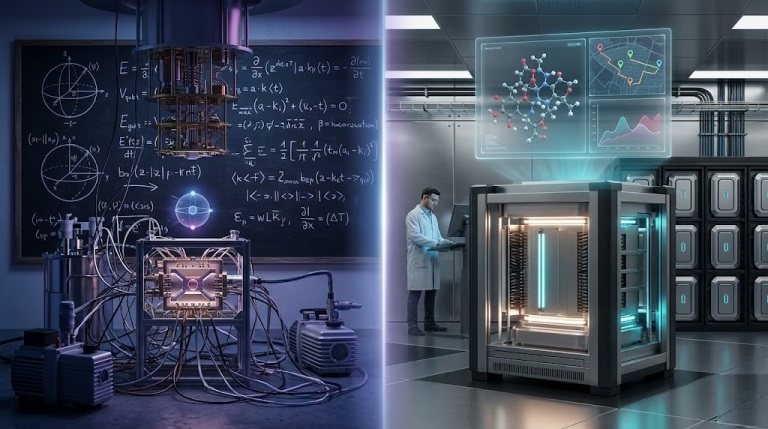
Traditional computers use bits—each one is either 0 or 1. Quantum computers use qubits, which can be 0, 1, or a blend of both at the same time through superposition. When qubits become entangled, changes to one can be correlated with changes to another, enabling powerful new computational strategies.
The catch has always been the same: noise.
Qubits are extremely sensitive. Heat, vibration, stray electromagnetic fields—even tiny imperfections—can introduce errors. For years, this made quantum outputs fragile, inconsistent, and hard to trust beyond controlled demos.
2024’s biggest progress is not just “more qubits.” It’s better qubits—plus smarter ways to correct them.
The Core Latest Breakthroughs in Quantum Computing 2024
1) Quantum Error Correction Hits a Real Milestone (Logical Qubits Improve as Systems Scale)
The most meaningful breakthrough in 2024 is progress toward fault-tolerant quantum computing—the point where a quantum computer can correct its own errors faster than noise destroys the calculation.
A key theme this year: logical qubits.
- A physical qubit is the actual device (superconducting circuit, trapped ion, neutral atom, etc.).
- A logical qubit is a more reliable qubit created by encoding information across many physical qubits, using quantum error correction (QEC).
In 2024, researchers demonstrated stronger evidence that increasing the size of an error-correcting code can reduce logical error rates, a critical requirement on the path to scalable quantum computing. This includes results discussed publicly by Google Quantum AI and related coverage and peer-reviewed reporting on operating below a surface-code threshold, which is essentially the “line” you want to cross so error correction starts helping more than hurting.
Why this matters: error correction is the bridge between impressive lab experiments and dependable machines that can run long, valuable algorithms.
2) Hardware Architectures Mature: Modularity and Better System Engineering
While QEC is the headline, the quieter breakthrough is engineering maturity:
- Improved control electronics and calibration pipelines
- Better cryogenic and isolation techniques (for superconducting systems)
- More robust compilation and scheduling to reduce error accumulation
- Early movement toward modular scaling (linking devices and subsystems instead of betting everything on one monolithic chip)
This is how quantum computing becomes infrastructure—not just hardware. In 2024, you can see the industry aligning around a practical truth: useful quantum systems will be built like data centers—layered, redundant, and engineered for uptime, not like single lab prototypes.
3) Neutral Atoms Keep Rising as a Scaling Contender
Alongside superconducting devices and trapped ions, neutral-atom quantum computing continues to stand out in 2024 for its scaling potential (large, grid-like arrays and flexible connectivity patterns).
Public roadmaps and industry reporting emphasize neutral atoms’ momentum in areas like scaling strategies and error-correction demonstrations, reinforcing why many teams consider them a serious candidate for long-term fault-tolerant machines.
Translation: 2024 doesn’t crown one “winner,” but it makes the competitive landscape clearer—and puts more emphasis on which platforms can support error correction at scale.
Transforming Industries: Where Quantum Helps First (and Where It Doesn’t)
A strong 2024 narrative is the rise of hybrid computing: classical computers do most tasks, while quantum processors act like specialized accelerators for specific hard subproblems.
Pharmaceutical + Materials Discovery (Early-Stage Acceleration)
Quantum computing is not “instantly inventing miracle drugs” in 2024—but it is increasingly used to improve simulation workflows, especially in chemistry and materials science where quantum mechanics is naturally involved.
The near-term value is typically:
- Better approximations in molecular energy calculations
- Faster evaluation of candidate materials
- Higher-quality early-stage screening (reducing expensive lab cycles)
Impact: it can reduce time and cost in R&D pipelines, especially when paired with classical HPC.
Logistics, Routing, and Scheduling (Optimization)
Quantum-inspired and quantum-assisted methods continue to be explored for:
- Route optimization
- Scheduling and resource allocation
- Supply chain modeling under uncertainty
In 2024, the practical takeaway is: optimization is promising, but “quantum advantage” is still problem-dependent—and often hybrid approaches are the best path.
Finance (Risk + Simulation Research)
Financial institutions continue experimenting with quantum algorithms for:
- Monte Carlo–style simulation acceleration
- Portfolio optimization research
- Risk modeling prototypes
But in 2024, most real deployments still emphasize research readiness rather than production replacement.
Blockchain Security and the Crypto Landscape (The 2024 Reality Check)

Quantum computing is often framed as a direct threat to crypto and internet security—and there is a real long-term concern: sufficiently capable quantum machines could break widely used public-key cryptography (like RSA and ECC) if they reach the necessary scale.
2024’s major breakthrough here is defensive: standardization.
In August 2024, NIST finalized the first post-quantum cryptography (PQC) standards, approving three Federal Information Processing Standards:
- FIPS 203
- FIPS 204
- FIPS 205
This is a big deal because it moves PQC from “research and drafts” into official standards that governments and enterprises can adopt.
What it means in plain terms
- The world is not waiting for a “cryptography apocalypse.”
- In 2024, the priority is migration planning: inventory cryptography, identify long-lived keys, update protocols, and start rolling out PQC where needed.
For blockchain ecosystems, the strategic message is simple: build upgrade paths now (wallet standards, signature schemes, and governance mechanisms) so networks can transition smoothly when timelines become urgent.
Embracing the Quantum Horizon (Without the Hype)
The latest breakthroughs in quantum computing 2024 show the field growing up fast. The most important wins are happening where it counts: error correction, reliability, and system-level engineering—the foundations required for true, durable quantum advantage.
Final Verdict
Quantum computing in 2024 stopped showing off and started showing up. Error correction finally works at scale, NIST locked in real security standards, and hybrid systems are quietly entering commercial pipelines. This isn’t hype anymore — it’s infrastructure being built in real time. Pay attention now or play catch-up later.
Also Read: How to Fix Google Chrome Hardware Acceleration Issues
Frequently Asked Questions
What is the environmental impact of running quantum computers?
They consume heavy energy now, but solve problems far faster than classical machines.
How will quantum computing change artificial intelligence?
AI will train smarter and faster — think days instead of years.
Can regular consumers buy a quantum computer?
Not yet — but cloud access for everyday users is already coming.
Will quantum computing make current passwords completely obsolete?
Not if post-quantum encryption standards roll out in time — and they are.
What role do neutral atoms play in the latest quantum research?
They’re becoming a flexible, powerful alternative to traditional superconducting qubit systems.
