

The slow PC is what will make the “one-click boost” promise seem attractive. It is more realistic to think about how the speed is achieved by identifying the bottleneck, altering a single variable, and then performing a test. When you seek assistance in terms of modding from LCFTechMods, you should seek to have your frames running smoothly without crashing or dangerous files.
Evidence note: LCFTechMods publicly describes itself as an independent publication and information resource, not a clearly documented PC-optimization application. LCFTechMods customer benchmarking or review trails were not available through independent verification in the course of research, and as such, the examples provided below are clear cases and not fabricated testimonies. Please note that searches for new software releases from LCFTechMods are suggestions to look up and not official announcements.
- 1. Measure First: Make Every Tweak Prove Its Value
- 2. Update Carefully: Newer Is Useful, Not Automatically Better
- 3. Reclaim the Resources Your PC Is Wasting
- 4. Give Windows and Games Room to Breathe
- 5. Beat Thermal Throttling Before Buying Hardware
- 6. Tune Heavy Graphics—and Diagnose Ping Separately
- 7. Build a Safe Wall Between Mods and Ranked Play
- Conclusion
- Commonly Asked Questions
1. Measure First: Make Every Tweak Prove Its Value
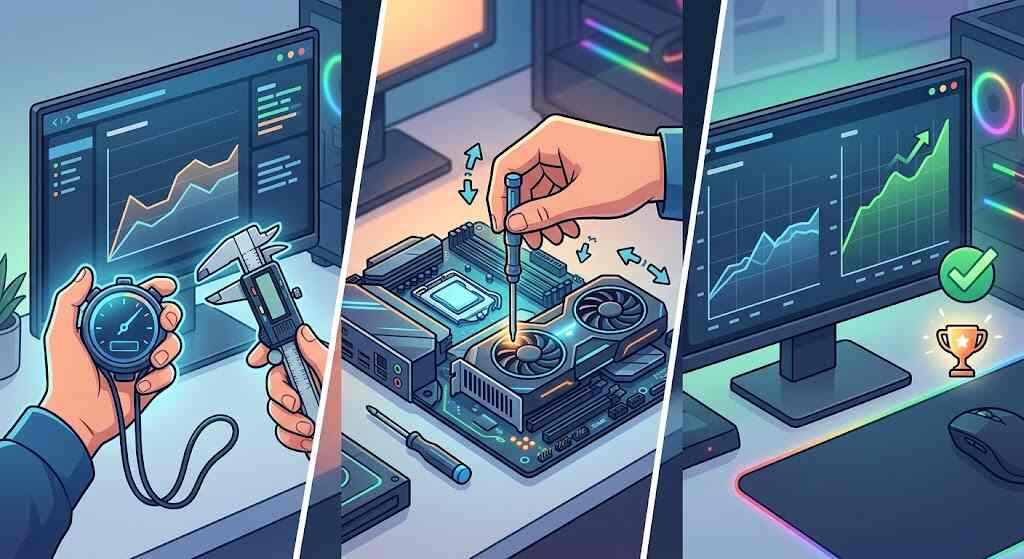
Run the Task Manager to log the CPU, RAM, and disk idle percentages. Execute the game scene for five minutes, then note down the FPS, lag, and loading time. However, if the disk idle percentage remains 100% and the GPU idle percentage is 0%, the solution is not overclocking the GPU. This is the baseline for LCFTechMods’ suggestions.
2. Update Carefully: Newer Is Useful, Not Automatically Better
According to Microsoft, it is good to always upgrade Windows and any optional driver since it comes with patches and enhancements. Graphics driver can be obtained from AMD, INTEL, NVIDIA, or your laptop brand. Always ask for version, date, changelogs, and origin of the source of any software upgrades from lcftechmods. Back up saves and setting; do not update anything prior to a big game.
3. Reclaim the Resources Your PC Is Wasting

Organize the Task Manager in terms of CPU, Memory, and Disk. End processes for unused browser tabs, launchers, recorder applications, and overlays. Close unimportant startup programs. Do not terminate unknown windows processes. Real-world example: on an 8GB computer, shutting down 20 tabs will decrease paging and stuttering even when the FPS remains almost the same. This is definitely an achievement.
4. Give Windows and Games Room to Breathe
Limited storage will affect the performance, and thus you should use Storage Sense, clean up your temporary files and also remove unused applications. Whenever it’s possible, install your often-played games to the SSD drive and allow Windows to optimize the drives; there’s no need for manual defragmentation of the SSD drive. Before deleting any LCFTechMods folders, back up the load order and config first.
Also Read: How to Identify Good GPU Temperature for Gaming
5. Beat Thermal Throttling Before Buying Hardware
Test the temperature and clock speed on startup, and then again after 15 minutes. If you find that there is a reduction in speed after some time, it could be due to heating issues. Turn off the computer, disconnect it from the mains and clear out any dust to improve cooling; for laptop users, ensure the vents are open. You can use “Best performance” setting when connected to electricity.
6. Tune Heavy Graphics—and Diagnose Ping Separately
Reduce ray tracing, shadow quality, volumetric lights, and crowd density rather than disabling all of these effects at once. It is recommended to have a reasonable FPS cap and to use Variable Refresh Rate technology. The Windowed game optimization in Windows 11 may reduce latency in DirectX 10/11 games. In multiplayer games, lcftechmods notes that low FPS vs. high ping are two different issues.
Also Read: How To Speed Up Windows 11 For Gaming
7. Build a Safe Wall Between Mods and Ranked Play
The CISA recommends downloading from the source and checking whether the version of the game works with the mod, scanning it, and installing mods one by one. It is advised by the CISA to scan the download from the internet before opening it. Have backup copies and different profiles compared to the modded one. In multiplayer games, the talks concerning lcftechmods, publishers, and anti-cheat come before blog advice.
Conclusion
Perhaps the best LCFTechMods technique remains very down to earth: measure, tweak, cut background load, free disk space, control heat, optimize game settings, and isolate mods. Then repeat the same test after every tweak, keeping changes that improve performance and reverting to previous state in case of degradation. While it might lack the allure of “200 percent boost”, it is much safer, economical, and effective in making the gameplay better.
Commonly Asked Questions
What is LCFTechMods?
LCFTechMods is claimed to be an independent source of information about video games and technology. There is no evidence that it is a universal optimizer, mod store, or benchmarking source.
Does every update of LCFTechMods software guarantee higher FPS?
Not always. Although every update of LCFTechMods may provide you with some useful information about updates, any improvement depends on your hardware, the game, and your current driver. Always check the official update log, test the same scene and remember that you can roll back.
Will these recommendations work for an old computer?
Yes, they may help you if you have an issue with too many startup programs or overheating. It will not make your old PC to satisfy requirements which are impossible to satisfy.
Is it safe to use LCFTechMods modification in online multi-player games?
It will be safe if the game allows LCFTechMods mods and the anti-cheat system supports them. Create a fresh account for competitive play.
Should I upgrade my computer to a new GPU or RAM first?
Let the statistics show you the way: upgrade your hard drive if it is still saturated, RAM if your PC runs out of the memory or GPU if it is constantly the bottleneck.
