

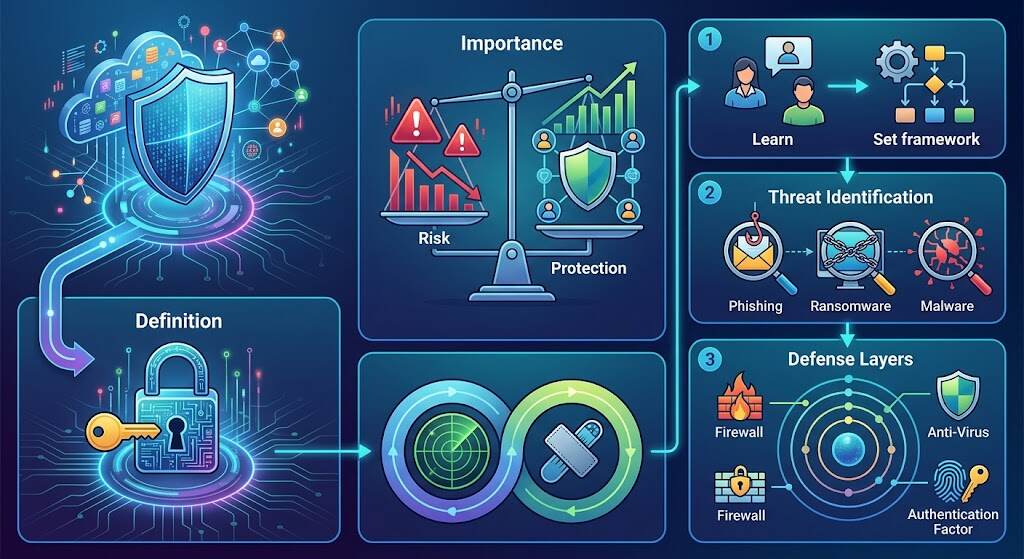
Cybersecurity is not just about firewalls and obligatory changing of passwords. Behind the stereotype of hooded hackers, there is a human face: this is the necessity to protect our online life, home, and business from any malicious intent to use or block access to our information.
- Cybersecurity, Defined Without the Jargon
- Why Cybersecurity Is Important: The 2026 Reality Check
- Types of Cybersecurity Threats, Explained Simply
- Examples of Cyber Attacks: What They Cost Real Organizations
- The Five Fronts Every Cybersecurity Plan Covers
- People, Processes, Technology: The Three Pillars
- The NIST Cybersecurity Framework: Chaos Into a Checklist
- Your 20-Minute Cybersecurity Starter Kit
- What’s Next: Shadow AI and the Quantum Clock
- Conclusion
- Cybersecurity FAQs
Cybersecurity, Defined Without the Jargon
Cybersecurity definition: refers to the process of protecting computers, networks, programs and data against any form of malicious attacks, access, or blackmail.
Think about cyber security like putting locks on all doors, setting alarms, and conducting fire drills for all of your online activities. In essence, there are three basic promises of cybersecurity that make up the CIA Triad: your information is private, correct, and available whenever you want to use it.
Why Cybersecurity Is Important: The 2026 Reality Check
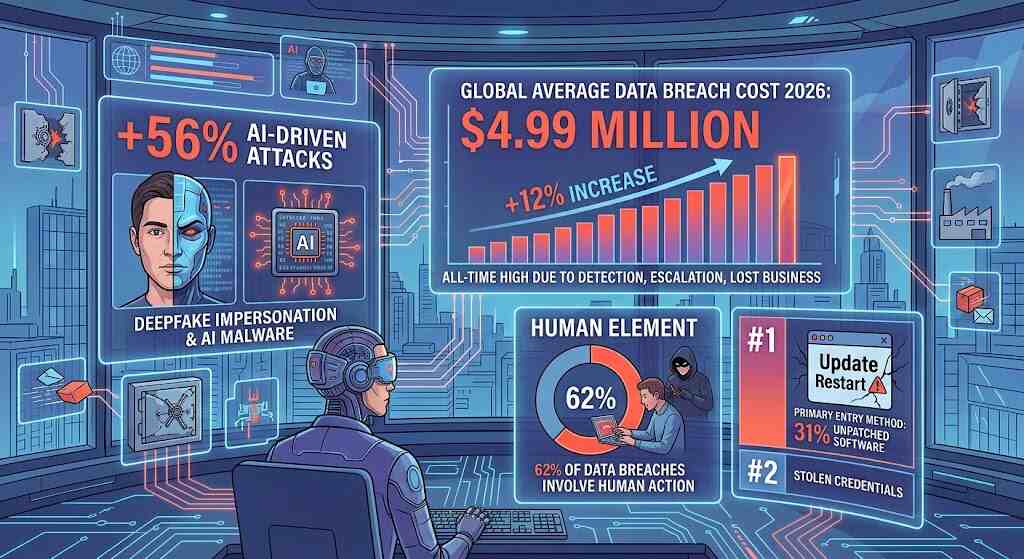
This year’s statistics make it much harder to swallow. According to the 2026 IBM Cost of a Data Breach Report, the global average cost has risen 12% to $4.99 million and reached an all-time high due to increased costs of detection, escalation, and lost business. The number of attacks carried out through artificial intelligence increased by 56%, with deepfake impersonation and malware using AI being the major sources.
In Verizon’s 2026 Data Breach Investigations Report, there is an interesting human angle: in 62% of data breaches, a person had performed some action that was needed by the hacker. For the first time in 19 years, the use of unpatched software (in 31% of breaches) became the main way of getting into the system, ahead of stolen credentials.
Types of Cybersecurity Threats, Explained Simply
Phishing and social engineering
A con, not a code. The message pretends to come from your CEO, messenger, or bank. Verizon learned that mobile scams, in the form of text and phone scams, work 40% better than email.
Ransomware
Padlock along with a blackmail message. Attack volume increased by 50% in 2026 compared to previous years, while payment amounts reduced by 8%, meaning more people are able to recover through backups instead of paying the extortioners.
Malware and AI-enabled attacks
Any malicious program, increasingly coupled with a replicated phone voice to confirm “an urgent transfer.”
Unpatched vulnerabilities
Just 26% of all known exploited vulnerabilities were patched in 2025 compared to 38%. This leaves a wide door open that attackers need not look for anymore.
Third-party and identity gaps
Vendor and SaaS compromise breaches made up 48% of all breaches. According to Sophos, 67% of the reasons behind incidents are associated with identity, with MFA missing from exactly those spots where it should have been present—VPNs, firewalls, and legacy apps—in 59% of the incidents.
Examples of Cyber Attacks: What They Cost Real Organizations
- Jaguar Land Rover (2025). The production line had been stopped for over a month. The company had recorded a loss of £485 million for the quarter and was considered the most expensive cyber attack incident ever witnessed in the UK by analysts. The government was ready to lend £1.5 billion.
- Marks & Spencer (2025). Offline online ordering had cost them losses amounting to about £300m, which resulted from the inability of the customers to order online.
- Minnesota water utilities (July 2026). The attackers infiltrated internet-exposed controllers at over 30 municipal water plants, changed passwords, and blocked access for operators. The message from CISA on this case was unambiguous: take the operational technology off the internet.
What customers tell after is rarely cinematic. It happens over several weeks of manual workarounds—suppliers laying off workers, orders written down, rural operators running between pump stations. The expensive part is not the invasion itself but the long and tiring process of recovery.
The Five Fronts Every Cybersecurity Plan Covers
- Network security — Next-generation firewalls, DNS filtering, segmentation.
- Endpoint security — Laptops and mobiles secured with antivirus and EDR.
- Cloud security — Principle of least privilege, clean configuration, application connectivity review.
- Identity and data security — Two-factor authentication, encryption, backups.
- Critical infrastructure and OT — Healthcare sector, water supply, electricity, manufacturing plants.
People, Processes, Technology: The Three Pillars
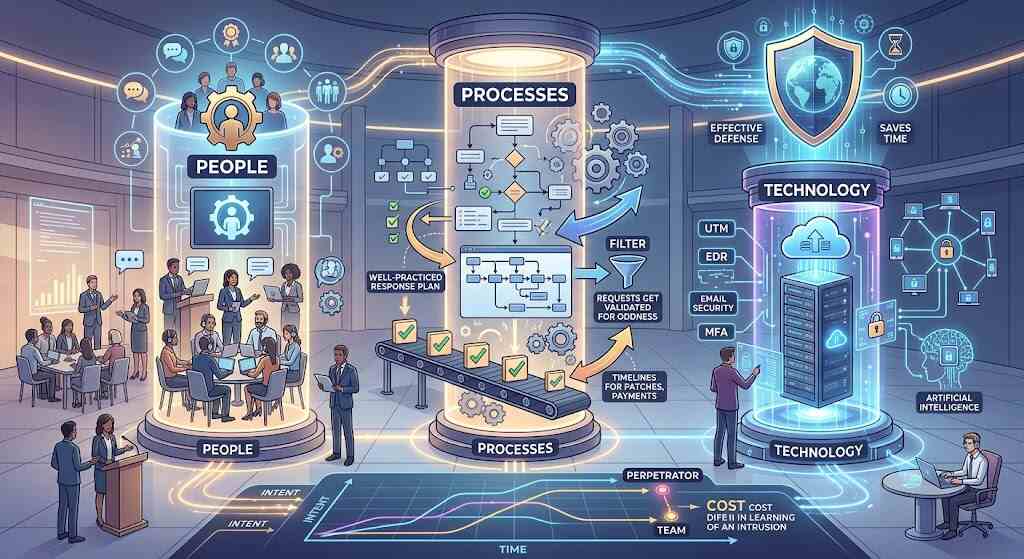
Requests get validated for oddness. Procedures create timelines for patches, payments, and a well-practiced response plan. Technology, whether UTM, email security, EDR, or MFA, saves time. According to IBM’s data, it is significantly more costly to learn of an intrusion from the perpetrator rather than your team.
The NIST Cybersecurity Framework: Chaos Into a Checklist
CSF 2.0 is open source and vendor neutral, organized into six categories: Govern, Identify, Protect, Detect, Respond, and Recover. Govern was incorporated to place responsibility on leaders. Begin with assessing your present state, establish your goal, and address the biggest gaps first.
Also Read: Cloud Security Tips: Best Practices & Key Benefits
Your 20-Minute Cybersecurity Starter Kit
Implement MFA/passkeys for everything—VPNs, admin panels, and even legacy systems. Make sure your devices are always updating automatically. Always use a password manager and never reuse passwords. Backup once using an offline method and test your restore regularly. For any change in payment method, verify by calling the trusted number. Have one AI rule: 67% of employees use AI on their work devices through personal accounts.
What’s Next: Shadow AI and the Quantum Clock
Shadow AI is the latest insider threat. Even encryption has its expiry date: NIST expects to make quantum-vulnerable encryption methods deprecated by 2030 and obsolete by 2035; Google wants to do so by 2029. In the meantime, hackers are gathering encrypted information and saving it for future decryption; begin your cryptography audit immediately.
Conclusion
While cybersecurity cannot be purchased all at once as a product, it is rather a series of practices making you a less attractive target. The bright side of the unprecedented breach costs seen in 2026 is that fast patching, comprehensive MFA, recovery exercises, and incident detection will reduce your damage significantly compared to others who do not perform such practices. There is no need for a security operations center to get started; you just have to install MFA right away, keep updating, and have one tested backup ready.
Cybersecurity FAQs
What does cybersecurity mean in plain language?
It means protecting hardware, software, systems, and data from cyber-attacks, which is like locking up your house, using a security badge, and storing an extra key somewhere safe.
What are the greatest cybersecurity threats of 2026?
These include unpatched software exploits (accounting for 31% of the incidents), phishing and deepfake fraud, ransomware, and third party compromises, and all of these are present in almost half of all breaches.
Is cybersecurity solely an IT issue?
No, as 62% of breaches are associated with individuals, financial, human resources, and leadership decisions are equally important.
Can small companies be targeted by hackers?
Yes, and not surprisingly, as smaller companies, especially lean teams and internet connected systems, are the easiest to attack, just ask Minnesota’s water utility firms.
What is the ultimate cybersecurity practice?
Using universal MFA/passkeys and having dependable backup systems should rank first and second in any list of cybersecurity practices.
Sources: IBM Cost of a Data Breach Report 2026; Verizon 2026 DBIR; Sophos State of Ransomware 2026; NIST CSF 2.0 and IR 8547; CISA advisories (AA26-097A); Reuters, BBC, and Guardian reporting on the JLR and M&S incidents.
