

Python bug 54axhg5 is not a standard Python exception. Treat it as a non-standard identifier that may point to a real traceback, failed request, deployment event, or log entry. The safest response is to verify where it appeared, capture the surrounding evidence, and diagnose the actual exception before changing code, packages, servers, or production settings safely and calmly today now.
Do not pretend every strange code is a known software defect. That is how developers lose hours and break stable systems. python bug 54axhg5 deserves disciplined investigation, not a copy-paste fix.
Start With the Evidence, Not the Keyword
The first question is not “How do I fix python bug 54axhg5?” The first question is “Where did this string appear?”
If it appeared inside a Python traceback, the real issue may be near the final exception line. If it appeared in a log dashboard, it may be a correlation ID. If it appeared in a browser error page, it may be an internal support code.
Here is a realistic example of how a non-standard Python identifier can appear without being the actual bug:
2026-05-30T10:42:18Z ERROR service=payments request_id=54axhg5
event="checkout_failed" runtime="python3.12"
Traceback (most recent call last):
  File "/app/payments/processor.py", line 81, in charge_card
    amount = int(payload["total"])
ValueError: invalid literal for int() with base 10: '19.99'
In that log, python bug 54axhg5 is not the cause. The cause is a ValueError triggered by converting a decimal string to an integer. The identifier locates the failed request; the exception explains the fix.
Decode the Identifier Before You Fix Anything
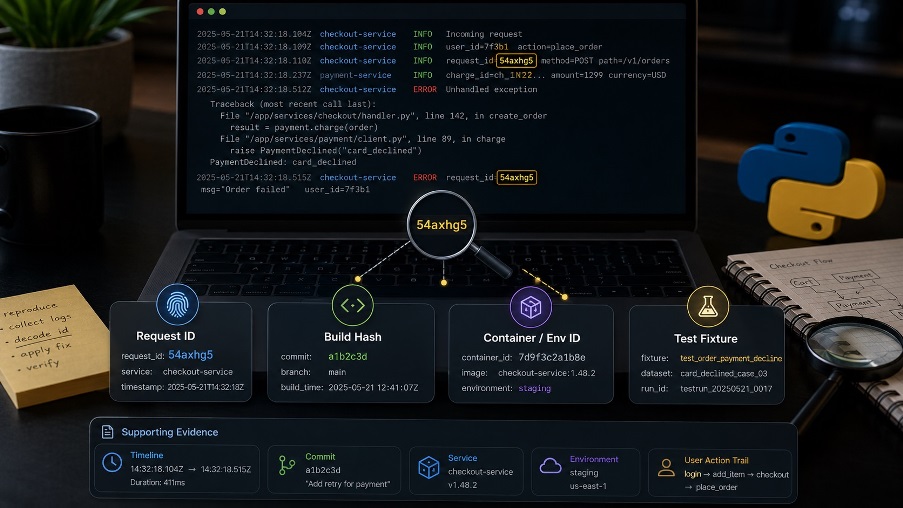
When python bug 54axhg5 appears, classify it before acting. A random-looking code can come from different layers of the stack.
It may be a request ID generated by an API gateway. It may be a build hash created by CI/CD. It may be a container ID fragment from Docker or Kubernetes. It may be a test fixture in a failing unit test.
Check the source. Look at timestamps, service names, environment labels, commit hashes, and user actions around the same event. A serious process connects the identifier to system evidence instead of treating it as a magic phrase.
Use a Clean Diagnostic Sequence
Run only safe inspection commands first. These commands do not rewrite your project or hide the original state.
python --version
python -m pip --version
python -m pip check
python -m pip freeze | sed -n '1,80p'
If python bug 54axhg5 is attached to an import failure, compare the active interpreter with the environment where the package was installed. Many Python incidents come from running one interpreter and installing packages into another.
If the identifier is attached to a deployment failure, compare local, staging, and production values. Focus on Python version, dependencies, environment variables, secrets, database access, file paths, and operating system differences.
If the same label appears during traffic spikes, inspect resource pressure. A timeout, memory error, worker crash, or queue delay may produce a noisy identifier while the real issue sits in infrastructure.
What a Real Fix Looks Like
A real fix addresses the exception, not the label. If the traceback shows ModuleNotFoundError, fix the package install path or deployment image. If it shows ValueError, fix input parsing and validation. If it shows PermissionError, check file ownership, container permissions, or cloud credentials.
For this issue, the safest rule is simple: no change without a matched cause. Do not upgrade every package because one page says dependencies may be involved. Do not reinstall Python because a log contains a strange token.
Export package versions before deleting environments. Capture the failing command before editing configuration. That is the difference between troubleshooting and gambling.
A Better Workflow for Teams
Teams should document how their systems generate identifiers. If your API gateway, logging library, or tracing tool creates IDs like python bug 54axhg5, say so in the runbook. A junior developer should know whether that string is a request ID, trace ID, build marker, or application error code.
Enrich your log telemetry by including explicit structured fields like request_id, trace_id, service, runtime, version, and exception_type. When the same label appears again, those fields show whether the same request failed, the same deployment caused it, or the same exception repeated.
Keep one strong page for non-standard Python identifiers instead of publishing dozens of thin pages for every random code. That page can explain how to decode strings, read logs, and confirm real Python exceptions.
Also Read: How To Handle Cloudflare With Python Web Scrapers
Four Decisions Before Escalating
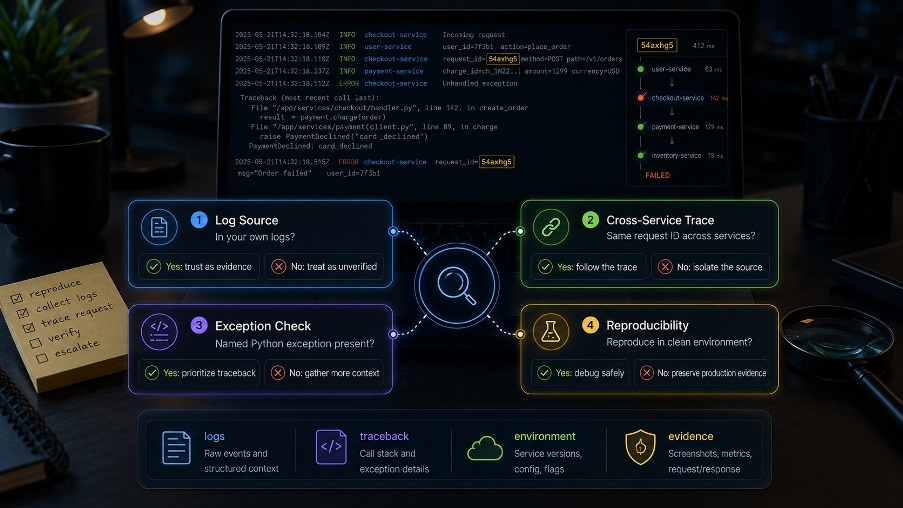
Is the identifier present in your own logs, or only in search results? If it is only in search results, do not treat it as evidence.
Does the same request ID appear across multiple services? If yes, follow the trace through the system.
Does the traceback include a named Python exception? If yes, prioritize that exception over the random-looking code.
Is the error reproducible when triggered inside a completely fresh, isolated setup? If not, preserve the production evidence before changing anything.
Practical Takeaway
Python bug 54axhg5 should be handled as a clue, not a diagnosis. It may help locate a failed request, but it does not replace the traceback, logs, environment details, package list, or deployment history. The winning move is simple: identify the source, confirm the real exception, reproduce the failure safely, then apply the smallest fix that matches evidence exactly.
