

Most outreach problems start long before the first email is sent. You may spend hours building account lists, researching prospects, and writing personalized messages, then wonder why replies never come. Many sales teams blame copy or subject lines when outreach underperforms.
The real issue usually starts with timing. You can write a thoughtful message for the wrong company at the wrong moment. A polished email still gets ignored when no buying activity exists inside the account. Another prospect may reply quickly because research already started before your message arrived. This explains why buyer signals matter so much.
Real-time buyer signals show what companies are doing right now. Sales teams gain visibility into activity happening inside accounts instead of relying only on company size or industry filters. GTM AI uses those signals to guide outreach decisions, which helps teams contact buyers when interest already exists.
- What Real-Time Buyer Signals Actually Tell You
- Why Outreach Breaks Without Buyer Signals
- How GTM AI Uses Buyer Signals During Prospecting
- Buyer Signals Make Emails More Relevant
- Timing Changes Outreach Results
- How GTM AI Fits Into Daily Outreach Work
- Buyer Signals Help Marketing Teams Too
- Why Context Makes Buyer Signals More Useful
- Better Outreach Starts With Better Timing
What Real-Time Buyer Signals Actually Tell You
Buyer signals are actions tied to business activity. These signals help you understand when a company may enter a buying phase or evaluate solutions.
A company researching software sends one signal. Hiring growth inside revenue teams sends another. Leadership changes may also point toward new priorities inside an organization.
These signals answer a simple question – Why should outreach happen now?
Many sales teams build prospect lists using broad filters. Industry, revenue, and employee count help narrow a market. Those details still do not explain urgency.
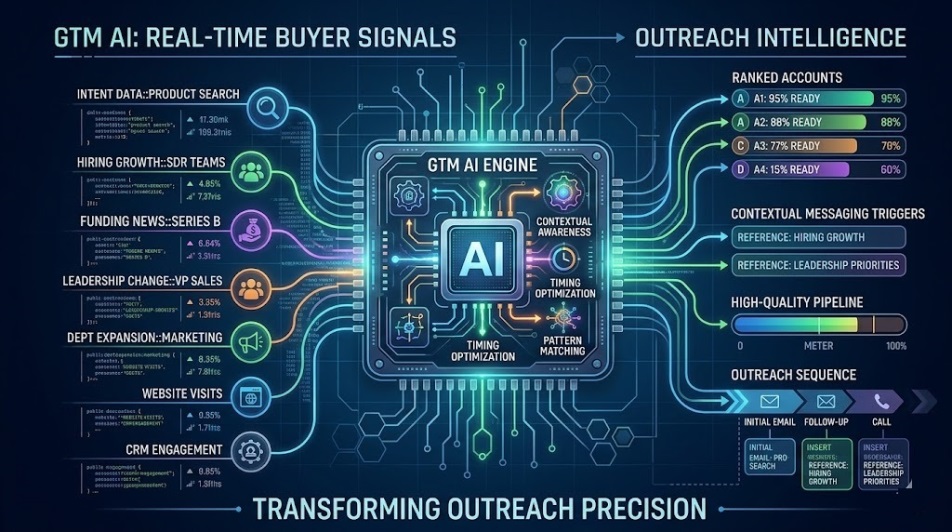
Real-time buyer signals may include:
- Product category research
- Hiring inside sales or marketing teams
- Job changes among decision-makers
- Funding tied to company growth
- Department expansion across revenue teams
- CRM engagement from previous conversations
- Website visits connected to account activity
Each signal adds context to the account. Hiring may suggest growth. Research activity may show active evaluation. Leadership changes may introduce fresh decision-makers who review existing tools. You gain a clearer reason to reach out.
Why Outreach Breaks Without Buyer Signals
Many outreach campaigns fail because teams contact accounts without understanding timing. A company may fit your ideal customer profile while showing zero interest in buying. Another business may actively evaluate products while staying hidden inside broad prospect lists.
Surface-level targeting causes this problem. Industry fit helps narrow your audience. Company size helps remove poor matches. These filters still cannot explain who deserves attention first.
Imagine sending outreach to fifty companies inside one vertical. Several prospects may never respond because no active need exists. Sales reps then assume messaging needs improvement even though timing caused the problem.
Poor timing leads to wasted effort. You may spend hours building sequences for cold accounts. SDR teams may contact buyers with no research activity. Marketing campaigns may target businesses without demand signals. Buyer signals help reduce guesswork because they reveal where interest already exists.
How GTM AI Uses Buyer Signals During Prospecting
GTM AI connects AI with live business intelligence linked to account behavior. Generic AI works from language patterns gathered across public information. GTM AI works from signals tied to what companies are doing today. This context comes from ZoomInfo and connected GTM workflows.
A rep may ask for companies researching sales software. Generic AI may return businesses inside a target industry. GTM AI can narrow those results using intent signals linked to active research.
Another salesperson may search for companies expanding revenue teams. GTM AI can identify businesses hiring SDRs, account executives, or sales leadership. This gives outreach more direction because account activity guides prospecting decisions. You stop relying on assumptions alone.
Buyer Signals Make Emails More Relevant
Many sales emails sound similar because research stops too early. Buyers receive messages about growth, efficiency, or productivity every day. Generic personalization no longer gets much attention.
Buyer signals give you something useful to reference. Imagine reaching out to a company hiring across sales teams. Your message can connect directly to team growth. Another company may research CRM software, which gives you a reason to discuss evaluation needs. These signals help you write with context instead of writing from assumptions.
Useful outreach angles may include:
- Hiring activity inside revenue departments
- Leadership changes linked to fresh priorities
- Intent signals tied to software research
- Expansion into new markets
- Department growth tied to funding
A message connected to business activity sounds more relevant because timing supports the conversation. You stop opening emails with broad statements. Buyers receive outreach tied to something already happening inside their company.
Timing Changes Outreach Results
Two companies may share the same industry. Revenue size may also match closely. Employee count may place both accounts inside the same segment. Their buying readiness may still differ completely.
One company may actively research vendors. Another account may delay spending for several months. Basic filters treat both companies similarly because surface-level matching misses account activity.
Buyer signals separate those accounts. Sales teams can prioritize companies showing momentum instead of spreading effort across large lists. This helps reps spend time where buying interest already exists.
Timing helps with:
- Better account prioritization
- Smarter follow-up planning
- Faster prospect research
- More relevant messaging
- Higher-quality pipeline targeting
You spend more time on accounts worth contacting.
How GTM AI Fits Into Daily Outreach Work
Sales reps need practical information during busy prospecting days. GTM AI brings buyer signals directly into workflows so research takes less manual effort.
You may start the day reviewing target accounts. GTM AI can surface companies showing hiring growth or research activity. Those signals help narrow focus before outreach begins. A rep preparing for outreach may review:
- Hiring activity inside target accounts
- Intent data tied to product categories
- CRM engagement from previous conversations
- Leadership changes among decision-makers
- Relationships between stakeholders
This context supports better outreach decisions. You no longer need to search across several tools to understand account activity. Buyer signals bring useful context into one workflow.
Buyer Signals Help Marketing Teams Too
Marketing teams benefit from buyer signals for many of the same reasons. Campaign targeting improves when audience selection connects to business activity.
Broad segmentation reaches large audiences. Signal-based targeting helps marketers focus on companies showing active interest.
Intent data may reveal accounts researching a category. Hiring growth may point toward expansion. Leadership changes may support fresh campaign messaging.
Marketing teams can use buyer signals for:
- Account-based marketing campaigns
- Audience segmentation
- Demand generation targeting
- Personalization across campaigns
- Retargeting using engagement activity
Sales and marketing teams work better when both sides use shared context. Campaigns support outreach more effectively because targeting comes from live account behavior.
Why Context Makes Buyer Signals More Useful
Buyer signals work best when paired with context. Hiring activity means little without understanding department growth. Product research gains value when tied to buying stages. Leadership changes help more when connected to account priorities.
Context explains why a signal deserves attention. GTM AI connects buyer signals with intelligence from ZoomInfo so AI can understand how account activity connects to prospecting decisions.
You receive recommendations tied to business behavior instead of isolated data points. This gives sales teams clearer direction.
Also Read: NS Mainframe: Unlocking Its Power in Modern IT
Better Outreach Starts With Better Timing
Sales teams spend time improving subject lines, personalization, and follow-up sequences. Those improvements help after account selection happens.
Buyer signals improve the earlier stage of outreach. You identify companies showing interest before writing begins. Messaging gains direction because timing already supports the conversation.
GTM AI connects AI with live account activity so prospecting decisions come from real business behavior. Outreach becomes more useful because signals guide account selection.
You spend less time chasing cold accounts and more time speaking with buyers already showing interest. Better outreach starts when timing supports every message.
