
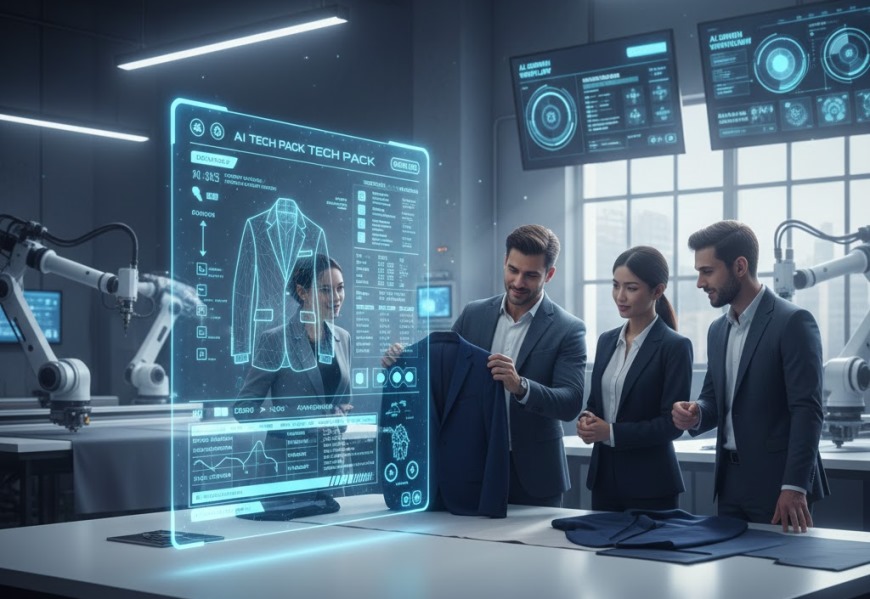
In the apparel and product manufacturing industry, clarity is everything. A small
misunderstanding can turn into a costly affair, leading to unnecessary delays, material waste, and even costly revisions. How do you avoid this? It is here that a tech pack makes its presence felt. Generally used by fashion brands and product developers, this product serves as a blueprint that helps to convert ideas into manufacturing instructions. And with advances in technology, AI tech packs are changing how accurate this process can be. These tools use NLP and computer vision for spec extraction.
What is a Tech Pack and Why is it so Crucial?
A technical package is an extensive document that highlights every detail required to
manufacture a product. For example, if you are manufacturing garments, the document will include specifications such as measurements, labeling instructions, materials to be used, and the overall quality standard. This includes spec tables, SPI counts, and ISO 4916 seam codes. In other words, it is a universal language that designers, manufacturers, and suppliers easily understand. When this package is well-prepared, it reduces ambiguity and sampling errors, ensuring that the final product matches the original version.
The Challenges of Traditional Tech Package
When the tech package concept was introduced, it was a time-intensive, manual task. The designers used to spend hours documenting the details, revising the charts, and updating the references almost every single time. Although this level of detail is necessary, it can significantly delay the manufacturing deadline. For startups and small businesses, this can be quite challenging. Thankfully, the AI-generated tech packs are changing all this.
By using artificial intelligence, modern tools are analyzing the design inputs from sketches to specification details and generating the technical document automatically. CNNs map flat sketches to construction parameters automatically. Instead of doing away with the tech packages, the AI version is making them all the more accurate and crucial for use in the apparel industry.
Also Read: The Best AI Image De-Blurring Tools Compared: SoftOrbits vs. Luminar vs. ON1
How is the AI-Generated Version Changing the Workflow?
One of the major benefits of this AI version is its speed in generating all the necessary details. What generally took hours or days can now be done in a matter of minutes. This means it is enabling a faster design-to-production cycle. Consistency is another crucial benefit here. The AI version helps generate a standard format and terminology, thereby fostering uniformity. Hence, it is easier for your global manufacturing partners to interpret instructions more quickly. If you want to eliminate miscommunication, reduce sampling costs, and improve production rates, you need to incorporate AI tech packs
into your business.
Speed, Accuracy, and Efficiency Through AI
Efficiency is just one of the perks of the AI tech packs. It also enhances collaboration. The cloud-based version allows the team to update the details required in real time. WebSocket protocols enable real-time multi-user synchronization. This comes in handy, since the manufacturers are working around the clock, and the latest specifications help them upgrade the work they have done. With AI automation in place, the designers can now concentrate more on innovation and creativity. They will not be bogged down with repetitive documentation tasks.
The Future of Apparel Production: Final Thoughts
As the fashion and production industries continue to grow and evolve, the incorporation of
digital workflows is becoming the norm. Those who opt for the AI tech packs are at an
advantage in comparison to their competitors. The faster turnaround time, enhanced accuracy, and the scalable processes – all ensure that the work gets done in a refined manner with little or no error.
