

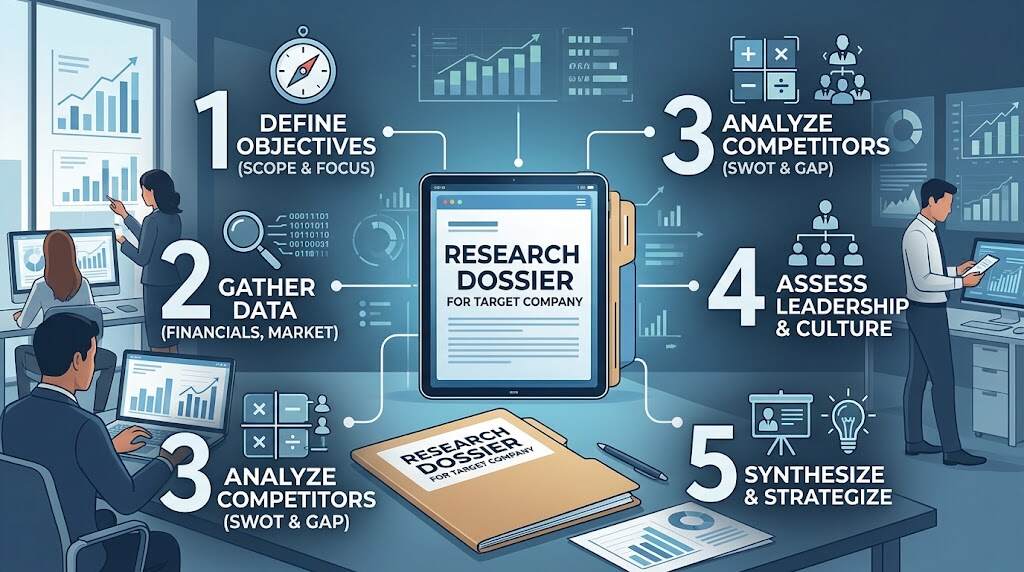
There’s a moment when preparation becomes visible. The candidate who quotes last quarter’s earnings call. The rep who names a supply-chain headache the buyer hasn’t admitted to yet. That isn’t charisma — it’s a target company research dossier, built on purpose.
The stakes are clear: with 70% to 90% of M&A deals failing to hit their original targets, superficial diligence remains the leading culprit.
- Step 1: Decide What the Dossier Must Prove Before You Open a Single Tab
- Step 2: Go Straight to Primary Documents — Filings Beat Blog Posts
- Step 3: Map the Humans — Who Holds Budget, Power, and Grudges
- Step 4: Mine the Unfiltered Channels Where the Real Story Leaks
- Step 5: Compress to One Page, Then Attack Your Own Findings
- What This Looks Like in Practice
- FAQs About Research Dossier for Target Company
- The Dossier Is the Work, Not the Homework
Step 1: Decide What the Dossier Must Prove Before You Open a Single Tab

“Should we pay $30 million for this?” is a completely different document than “Will I still respect my manager in eight months?” A research dossier for target company assessment goes stale the moment it has no thesis — forty pages of charts, no point of view.
Write three decision questions and three disqualifiers at the top of the page; the disqualifiers do the heavy lifting. A common rule in mid-market corp dev: if the top two customers exceed 35% of revenue, the answer isn’t a better deck, it’s a different price. Your company research answers those six lines and skips the rest.
Step 2: Go Straight to Primary Documents — Filings Beat Blog Posts
Secondary coverage is somebody else’s summary; primary documents are evidence. The SEC’s EDGAR full-text search reaches back more than twenty years: read the 10-K risk factors, then search competitors’ filings for your target’s name to see how rivals describe them when nobody’s watching. That alone yields better competitive intelligence than most paid reports.
Private targets leave trails too — court dockets, trademark filings, archived pricing pages, job ads. Postings are the most underrated input in any research dossier for target company analysis: twelve open reliability-engineering roles say more about product stability than a press release.
Step 3: Map the Humans — Who Holds Budget, Power, and Grudges
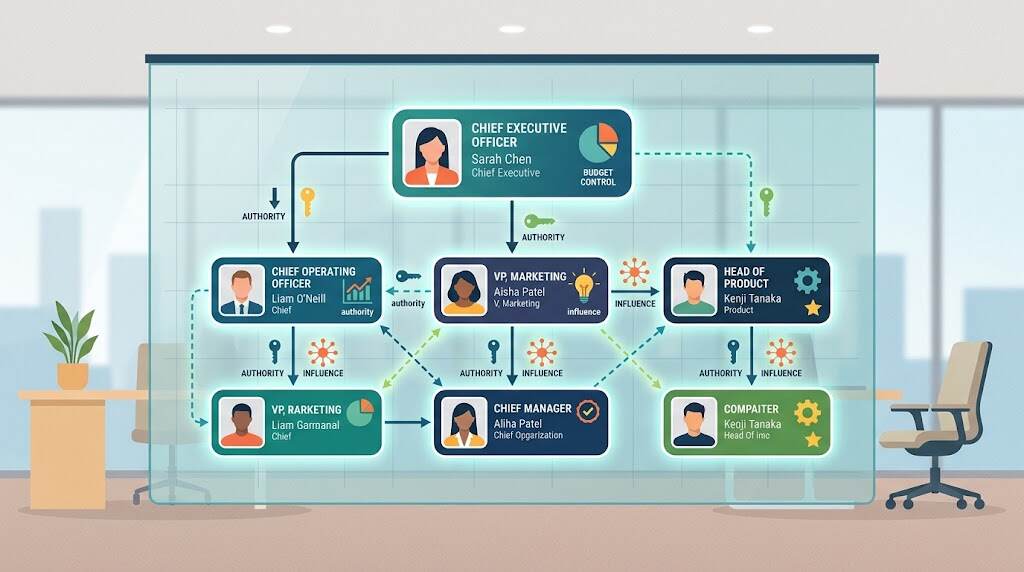
Org charts lie; behavior doesn’t. Map who joined in the last 18 months, who left, where they came from, and what they publish. A VP hired out of a process-heavy enterprise brings that playbook along.
This is where your dossier earns its keep: conference talks, podcasts, and LinkedIn threads reveal priorities no official page states. Verify reporting lines where you can; label the rest assumptions.
Step 4: Mine the Unfiltered Channels Where the Real Story Leaks
Around 86% of job applicants look at Glassdoor reviews before applying for jobs, and according to Glassdoor’s Worklife Trends 2026 report, “misalignment” and “distrust” have increased by 149% and 26% respectively, which can be used as a useful indicator while researching the company prior to an interview.
Treat reviews as pattern data, never verdicts. One furious post is noise; the same reorg complaint across Blind, Reddit, and three exit conversations is a finding. Add support forums and churn chatter, and your evaluation starts describing reality instead of branding.
Step 5: Compress to One Page, Then Attack Your Own Findings
It won’t be used if it does not fit on one page. Structure it: thesis, five facts with dates and sources, three open risks, three questions you’ll ask live.
Then red-team it. Ask what would have to be true for your conclusion to be wrong, and tag every claim verified, reported, or inferred. That habit separates credible target company analysis from a confident guess, and it’s the discipline behind any due diligence checklist.
Also Read: Startup Booted Financial Modeling: Validate Your Growth Idea
What This Looks Like in Practice
- The interview flip. Candidates who read the hiring manager’s own conference talk report warmer final rounds — interrogation becomes collaboration.
- The cold open. Cognism’s 2025 research found average cold-call length rising from 83 to 93 seconds; that breathing room goes to reps who open with something specific.
- The deal save. Buyers who read competitor filings before the management presentation catch pricing pressure the target’s deck omits — a well-researched dossier paying for itself in one line.
FAQs About Research Dossier for Target Company
1. How long should it take to build a dossier?
Two to four focused hours for an interview or sales call; days or weeks for an acquisition. Match depth to the decision.
2. What goes inside it?
Thesis, funding snapshot, people map, customer feedback, competitive intelligence, risks, and live questions. Keep raw sources as appendices.
3. Is this the same as a due diligence checklist?
No. A due diligence checklist verifies claims; a research dossier explains what they mean.
4. Can AI build it for me?
AI speeds up collection but can’t judge credibility. Verify every number against a primary source first.
5. How often should it be refreshed?
Before every major touchpoint. Leadership changes, funding rounds, and layoffs invalidate company research fast — especially when deciding how to research a company before an interview that’s already booked.
The Dossier Is the Work, Not the Homework
Everyone in the room has the same public information. The advantage never comes from finding secrets; it comes from reading ordinary sources more carefully than anyone else and forming a defensible view before the meeting starts. Building a dossier forces exactly that. It turns scattered browsing into an argument, replaces nerves with specifics, and makes you the one asking the question nobody else thought to ask. Build it properly once and you’ll stop improvising through conversations that decide your career or your capital.
