

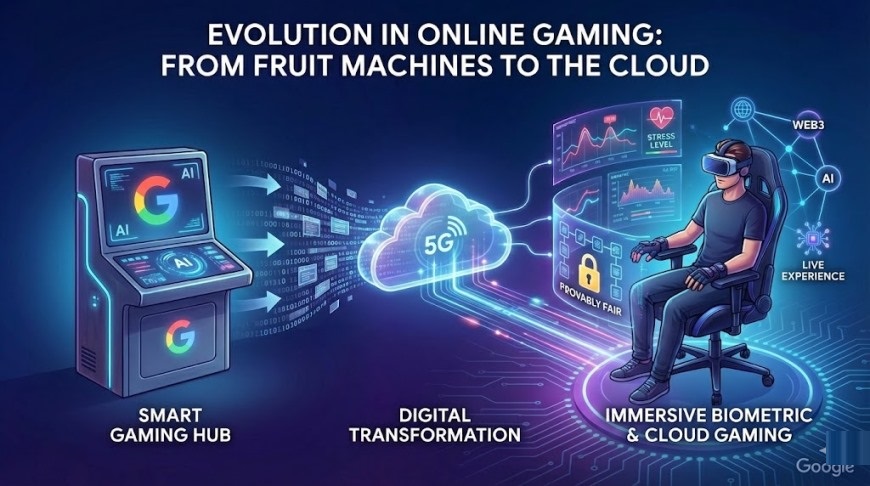
Online gaming has never been as exciting as in the era we are living in. Numerous technological innovations are transforming what were simple mechanics into complex, immersive, and thrilling adventures. Technologies like 5G networks, the advent of AI, VR gameplay, and live experiences are shaping a new environment for players all over the world.
Today, thanks to artificial intelligence and virtual and augmented reality, the user experience has also changed the online gaming industry, with users looking for engaging, safe, and fun experiences. If you are looking for no-deposit slots you can win cash from, Oddschecker offers a wide selection of safe and reliable platforms where you can play without any worries. And there is much news coming to this industry to make it even safer and more engaging.
From Passive Play to Biometric Interaction
Traditionally, slot machines have been reactive systems. The player clicks; the reels spin; the outcome is displayed. The interaction loop is linear and predictable. Biometric technologies introduce a new element to the games. Wearable devices such as fitness trackers, smart rings, and VR visors are being used to make each game more personalized and compelling. These devices can monitor:
- Heart rate
- Skin conductivity (a proxy for stress levels)
- Facial micro-expressions
- Eye movement and gaze tracking
With respect for the user’s consent, these indicators give platforms freedom to create more personalized gameplay. What is exciting and thrilling is preferred; what creates added stress is avoided, and the gaming experience becomes truly enjoyable.
This is not merely about engagement; it is also about responsibility. Biometric data can also serve as alarm systems for addiction and compulsive patterns, allowing platforms to intervene proactively when a user’s behaviour seems risky or dangerous. Companies like Aware have highlighted how biometric technologies can be deployed not just for security, but for responsible iGaming frameworks. In this model, online games evolve from static entertainment products into responsive digital environments—aware of the player’s state and capable of adjusting accordingly.
Multisensory Gaming in the Age of 5G
The expansion of 5G has made these innovations scalable. A headset equipped with integrated sensors can track head movement, measure pupil dilation, capture voice commands, and monitor stress indicators in real time. Combined with spatial audio and haptic feedback, the result is a multisensory gaming experience. Reels don’t just spin; they resonate. Wins don’t just flash; they vibrate through controllers or wearable devices. Gaming platforms are no longer flat interfaces—they are immersive environments shaped in real time by player data
Web3 and the Rise of “Provably Fair”
As engagement technology advances, so too does the demand for transparency. One of the long-standing concerns in online gambling has been trust. Players rely on Remote Game Servers (RGS) to generate random outcomes through RNG (Random Number Generator) algorithms. Traditionally, users must trust that these systems are fair based on regulatory certification. Web3 introduces a structural shift.
With blockchain integration, slot outcomes can be verified through “provably fair” technology. Instead of relying solely on a remote server, the RNG process is anchored to cryptographic hashes stored on a blockchain. Smart contracts automatically validate that the outcome was not manipulated. Through smart contracts, jackpot distributions and bonus triggers can also be transparently audited. The advantage is structural transparency. Trust is no longer institutional—it becomes mathematical.
Personalisation and Decentralisation
The intersection of biometric feedback and Web3 may seem paradoxical: one is deeply personal, the other radically decentralised. Yet together they signal the next phase of iGaming evolution. Biometrics personalise the experience while blockchain verifies its integrity. Artificial intelligence analyses behavioural patterns. Wearables interpret physiological signals. Smart contracts guarantee fairness. 5G ensures seamless delivery. The result is a gaming environment that is adaptive, transparent, immersive, and secure for users.
