

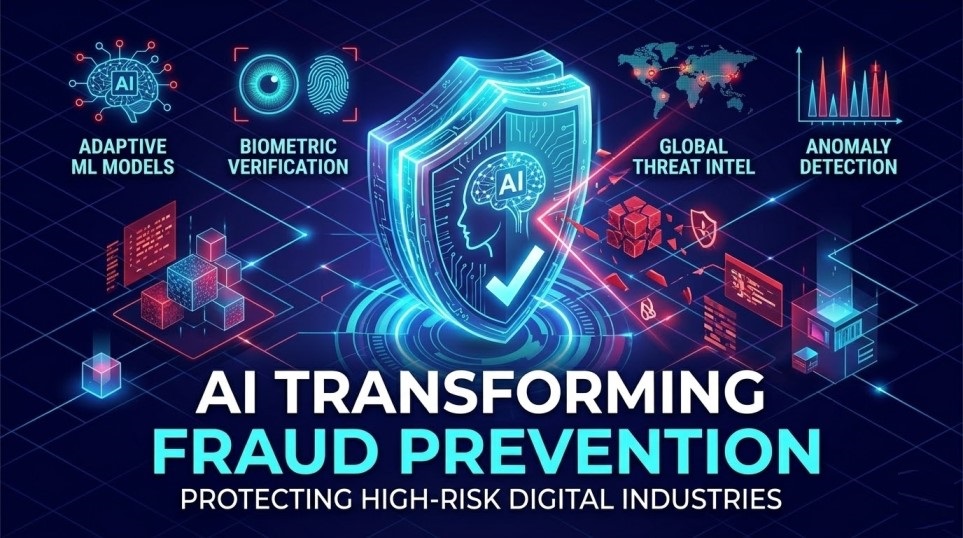
In a high-risk digital sector, trust is everything. If a first deposit is declined wrongly, the client will walk away, and if a fraudster does cash out using all sorts of other people’s money, the operator eats the loss and possibly regulatory wrath. iGaming has seen a significant rise in fraud, as payment velocity graphs are quite high, fraud is often automated, and attackers see the opportunity for fast repayment.
The threat is very real. Juniper Research predicted that merchant losses from online payment fraud could surpass $362 billion around the world over the next five years. The 2028 loss is projected at $91 billion. The increase is in part driven by fraudulent techniques that are becoming more automated and most convincing.
AI is revolutionizing fraud detection, locating where humans miss the pattern, reacting in real-time, and then learning patterns when criminals change. This is drastically changing the way teams decide to balance security and user experience, which is more important for businesses with conversion as a core KPI.
- Why iGaming is a fraud magnet
- The fraud types AI is best at stopping
- Account takeover and credential stuffing
- Bonus abuse and multi-accounting
- Payment fraud and chargebacks
- Synthetic identities and deepfakes
- What AI changes in the fraud stack
- Where AI delivers measurable wins
- A practical example of AI in action
- Final thoughts
Why iGaming is a fraud magnet
iGaming combines three ingredients favorable to fraudsters: money movement, digital identity, and incitement. All the major types of fraud fit into one place, often one after the other, within the player journey.
There has been a clear rise in AI-enabled scams and deepfake-driven abuse across several markets.In iGaming specifically, multiple datasets indicate that attempted fraud has surged over the last couple of years, and that the impact is not evenly distributed, with certain regions seeing sharper spikes tied to synthetic identities and spoofed verification.
The fraud types AI is best at stopping
AI performs best in environments where behavior is complex and signals are noisy — which accurately describes modern fraud.
Account takeover and credential stuffing
Trying credentials from a bot on a large scale; it seems a human analyst would not be fast enough in analyzing such volumes, meanwhile, using anomaly models to report the distinctive login velocity, device recycling, and location jumps.
Bonus abuse and multi-accounting
With clusters of accounts, the attackers raise promotions. Graph-based models use shared devices, payment instruments, behavior fingerprints, and timing patterns to connect identities.
Payment fraud and chargebacks
Chargebacks in high risk categories can demolish margins, hardly becoming economically viable even if the original transaction amount is smaller. An industry analyst specializing in chargebacks puts dispute costs well into hundreds of dollars per case when you throw in overhead for fees, and calls for a huge incentive to fraud on gaming and gambling.
Synthetic identities and deepfakes
The number of cases of ‘deep fake’ fraud is increasing in the digital sector. iGaming is particularly at risk because the rules on Know Your Customer (KYC) verification, age verification and geoblocking are different. As identity fraud techniques improve, criminals are using a mix of forged documents, face swaps and automated account creation, making it harder for traditional checks to tell real people from synthetic profiles.
What AI changes in the fraud stack
The most significant alteration is that crusading against fraud transforms into a living system rather than static rules. Of course, rules are still needed, but it is software that will tell you when to really apply them and when to be more restrictive.
- Collect signals from logins, devices, payments, gameplay, and withdrawals.
- Score risk in real time using supervised models trained on confirmed fraud and legitimate behaviour.
- Detect anomalies with unsupervised models that flag new tactics that do not match historic patterns.
- Link entities with graph analytics to surface account networks and mule rings.
- Choose an action that matches risk, from allow, to step up verification, to block, to manual review.
- Feed outcomes back into training data so the system improves as chargebacks and investigations resolve.
This workflow is essential for eliminating any guesswork while making sure the decisioning trigger is quick enough to beat live payments and instant game play.
Where AI delivers measurable wins
AI delivers on three meaningful indicators for optimum operator advantage in the market.
Lower fraud loss rate. Better detection reduces direct theft, bonus abuse, and chargebacks. The macro trend is clear in payments fraud forecasts, and operators feel it first.
Higher approval and conversion. If you can separate risky behaviour from legitimate users, you block fewer real players. This is where modern iGaming teams increasingly invest in automated decisioning rather than blanket friction.
Reduced manual workload. A large share of organisations still rely on manual processes, which are expensive and hard to scale. AI can shrink review queues by routing only high uncertainty cases to analysts.
| Common iGaming fraud patterns and AI signals | |||
| Fraud pattern | Typical attacker goal | AI signals that help | Best response |
| Account takeover | Drain balance or cash out | Device change, login velocity, impossible travel | Step up auth, lock, review |
| Bonus abuse | Farm promos | Shared device graph, timing similarity, repeated promo use | Promo limits, identity linking |
| Payment fraud | Deposit with stolen funds | BIN risk, chargeback history, mismatch patterns | Step up checks, block, 3DS strategy |
| Collusion | Rig outcomes | Unusual play correlations, shared IP clusters | Session monitoring, sanctions |
| Deepfake onboarding | Bypass KYC | Liveness anomalies, face mismatch, doc artefacts | Re capture, manual verification |
A practical example of AI in action
Let’s say we have a new player who puts money in, plays for a short time, and then asks to take their money out again really quickly. If there were a system that only had rules, it would ban all people who behaved like that, and this would hurt people who just wanted to play for a short time.
AI intervenes in a decision-making mechanism that identifies behavioral features and combines them with identity and device signals. Withdrawals could be authorized if behavior can be associated to known viable segments or will be diverted to enhanced verification if flagged in collusion.
In this sense, advanced solutions focused on the iGaming platforms are considerably pushing igaming fraud detection as an integrated mode to link identity, payments, and gaming signals into a single risk view, rather than regarding fraud on a payments-only paradigm.
Also Read: How to Identify the Best Phishing Simulation Tools for Your Business
Final thoughts
AI is used more and more in digital industries where there is a lot of risk of fraud. The old way was to use rules that should never change. This new model tries to stop fraud before it happens, rather than finding out about it after the event. It looks at the part of the customer journey where losses and chargebacks can happen.
In industries like online gaming, where speed is key to making sales, this change is good for artificial intelligence. It means fewer expenses and a better reputation for the company, while also being more popular. Engineers and fraud teams have a big job. They have to develop systems with strong models. These systems should clearly show a logical decision-making process. They also need human oversight. But fraudsters will always find new ways to trick people. AI allows fraud teams to adapt faster and became intelligent in responding to evolving threats.
Everywhere use the word “fraudster”. The word “Defrauder” is unnatural.
Sounds translated from russian. The correct version should be “iGaming has seen a significant rise in fraud.” or “Fraud challenges in iGaming are intensifying.”
“Fishing” in English usually means catching fish, if you mean the word “phishing it’s another sentence. Please correct this sentence this way “AI allows fraud teams to adapt faster and become more intelligent in responding to evolving threats.”.
