
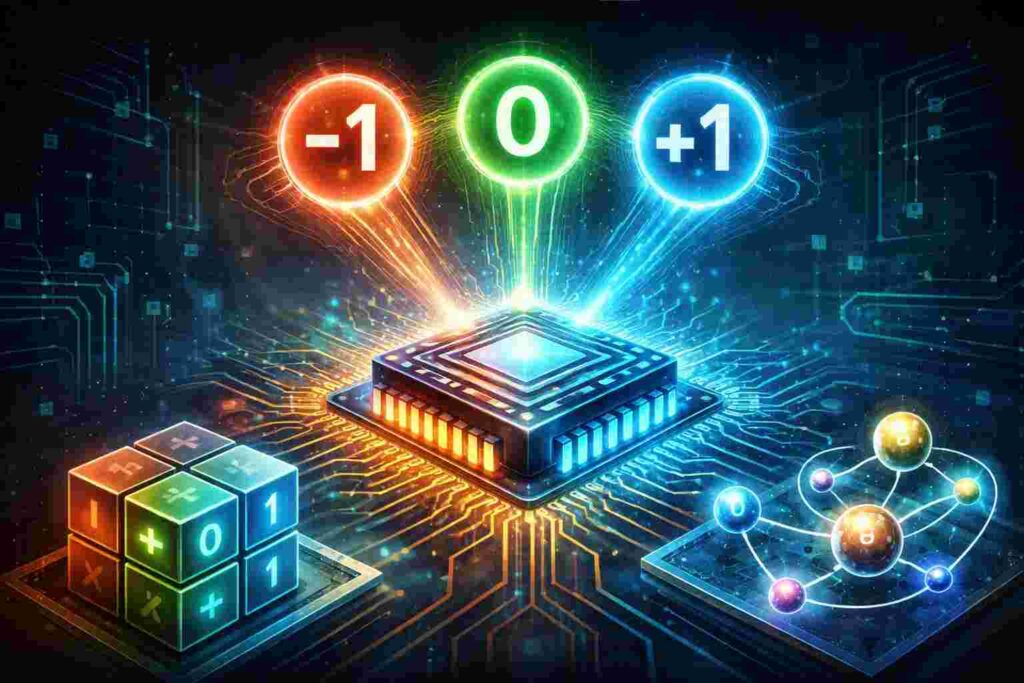
The concept of Ternary Computing seems to be a futuristic view, although it is not as recent as some people might think. It does not store or process two states as it would have to do; it processes three. That slight alteration can result in logic which is more eloquent and, in certain instances, more information-dense.
What is your reason? It is due to the fact that modern chip design is hitting hard limits in terms of power, heat and complexity. This is precisely the reason why scientists continue to reconsider non-binary architectures and raise the question as to whether binary always has to remain the norm.
Ternary Computing is also relevant as it facilitates betweens theory and actual engineering. It appears to have a real historical prototype in the Setun computer, and remains present in the literature on low-power logic, security hardware, and quatrain quantum systems.
What Is a Ternary Computer?
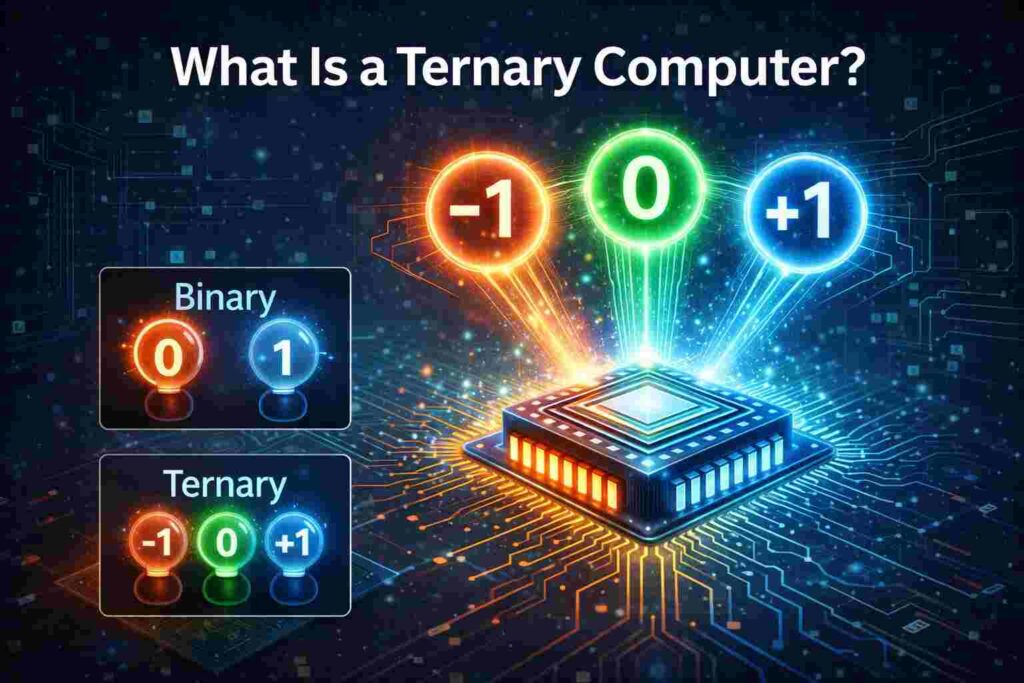
Ternary Computing involves use of trits in place of bits. The numbers of the two values of a bit are two and three respectively. Balanced ternary usually denotes such values as -1, 0 and +1, providing arithmetic with the desirable symmetry and making some representations more simplistic.
It is also mathematically true why ternary keeps reoccurring. Base 3 is only slightly farther away than the hypothetical optimum of maximum information efficiency and each trit has a value of about 1.585 bits. This does not necessarily make ternary hardware superior, but that is why engineers and theorists continue to listen.
The Reason Why Ternary is Important
Efficiency potential is the largest attraction. Newer reviews discuss ternary logic as a grave outside of binary alternative since three-state devices can alleviate interconnect strain, enhance information density, and decrease complexity in chosen designs. This is being examined by researchers with CMOS, CNT, RRAM, and implementations based on memristor.
| Feature | Binary | Ternary |
|---|---|---|
| Unit | Bit | Trit |
| States | 2 | 3 |
| Typical values | 0, 1 | 0, 1, 2 or -1, 0, +1 |
| Information per unit | 1 bit | ~1.585 bits |
| Ecosystem maturity | Very high | Limited |
Nevertheless, binary is the ruler where it counts most; scale. Mature fabs and tooling and binary system standards already exist in industry and not a math equation but a highly developed ecosystem needs to be beaten by ternary.
Coding Non-Binary Architectures Practice
Coding of ternary machines is not binary programming with an added symbol riveted on. Data representation changes. Arithmetic changes. Logic gates change. Decision-making, even, can be different as a system can inherently model negative, neutral, positive states.
In practice, developers might have to operate with:
- Number systems Ternary number Systems based on balances balanced ternary numbers.
- Comparators, multiplexers and tertiary adders.
- Ternary NOT and XOR-type gates.
- Binary-to-ternary compatibility layers
- Special simulators and compiler support.
Such is the challenge and such is the thrill. Ternary Computing is an invitation to the stack, hardware, software, and the rest, to consider a new way.
Where Ternary Computing Shows Promise
Low-power hardware and post-CMOS research
This is among the best applications. Post-CMOS and emerging-device research is investigating ternary logic since with three reliable stable states, designers can achieve more work with fewer wires and more flexible logic units.
Qutrit systems, security and AI.
Other scholars think that ternary hardware has a chance to enhance information assurance by providing architectural variety that is not anticipated by usual binary-centric attacks. Simultaneously, qutrit studies retain ternary concepts on quantum computing due to the capability of three-level systems to provide more plentiful state spaces and in certain experiments provide a reduced circuit depth or a reduced number of parameters.
Image suggestion 2: Theoretical art of a three-way processor interconnected to an AI accelerator or quantum workflow.
Difficulties That Maintain Ternary Systems Niche.
Hardware reality is the largest blocker. A ternary chip requires stable three-level devices, well-behaved noise margins, reproducible fabrication, and non-binary-assuming software. It is an engineering not a branding challenge.
It has human factor, too. Programmers construct this training, libraries and career. Binary computing has something to build on over decades, and ternary research traditionally found its initial following in the lab and in prototypes and special-purpose hardware, but not in standard consumer goods.
Conclusion
Ternary Computing is no sham. It is a solemn architectural concept that has a mathematical beauty, historical validity and contemporary research applicability. It is most unlikely to make binary everywhere obsolete but it is one of the strongest reminders that the future of computing is not necessarily confined to zeros and ones.
Also Read: Latest Breakthroughs in Quantum Computing
FAQ
What does Ternary Computing mean?
It is a model of computing that employs three states rather than two, as much as unit of information is concerned.
What is a trit?
The tertiary equivalent of a bit is called a trit and is able to carry approximately 1.585 bits of information.
Has there been a tertiary computer?
Yes. The real life example is the Setun computer.
Is Ternary More superior than binary?
Not at all angles. It promises and is beautiful, but binary remains less problematic in production and operation on large scale.
quantum computing ternary logic Is it important?
Yes. Video Systems Qutrit-based systems operate on three-level quantum states and hence ternary thinking is very pertinent.
