


AI Insights DualMedia is DualMedia’s AI-focused media intelligence approach that helps businesses analyze channels, improve attribution, and make faster marketing decisions using integrated data and predictive insights.
- What AI Insights DualMedia Actually Means
- How AI Insights DualMedia Works
- Why Businesses Search for AI Insights DualMedia
- Core Use Cases That Matter Most
- Benefits You Can Realistically Expect
- The Missing Truth Competitors Usually Avoid
- AI Insights DualMedia vs Traditional Reporting
- How to Implement It Without Wasting Budget
- Is AI Insights DualMedia Worth It?
- FAQs
What AI Insights DualMedia Actually Means
Searchers looking for ai insights dualmedia usually want a direct answer, not vague commentary. The term refers to an AI-driven approach to media analysis that connects marketing data, audience behavior, campaign performance, and forecasting into one decision framework.
That matters because most teams still work with fragmented reporting. Paid search sits in one dashboard, social in another, CRM in a third, and revenue data somewhere else. DualMedia positions the concept around bringing those disconnected signals together so teams can act on insights instead of reviewing reports after performance drops.
This is also why related queries such as innovation news dualmedia matter. Google often rewards content that places the main topic inside a broader, credible subject ecosystem. If your page only defines the phrase but ignores AI strategy, analytics, first-party data, attribution, and media optimization, it will look thin.
A stronger page must answer four questions clearly:
- What is AI Insights DualMedia?
- How does it work?
- When does it create measurable value?
- What prevents it from working well?
How AI Insights DualMedia Works
At the technical level, ai insights dualmedia works by collecting data from multiple platforms, standardizing it, and applying machine learning or rule-based analysis to detect meaningful patterns. The goal is not more dashboards. The goal is better decisions with less lag.
A practical setup usually includes:
- Major Ad platforms such as Google Meta Ads and Ads
- Analytics tools such as GA4
- CRM systems for leads, pipeline, and sales outcomes
- First-party website data for behavioral signals
- Attribution and reporting logic to connect touchpoints across the journey
Once those inputs are aligned, the model can identify budget inefficiencies, audience shifts, weak creative performance, and conversion gaps. That is where DualMedia becomes more useful than standard reporting. Standard reporting tells you what happened. AI-supported analysis helps explain why it happened and what to do next.
That distinction is critical for SEO content quality as well. Users searching ai insights dualmedia are not only looking for a definition. They want a practical understanding of the system behind the phrase.
Why Businesses Search for AI Insights DualMedia
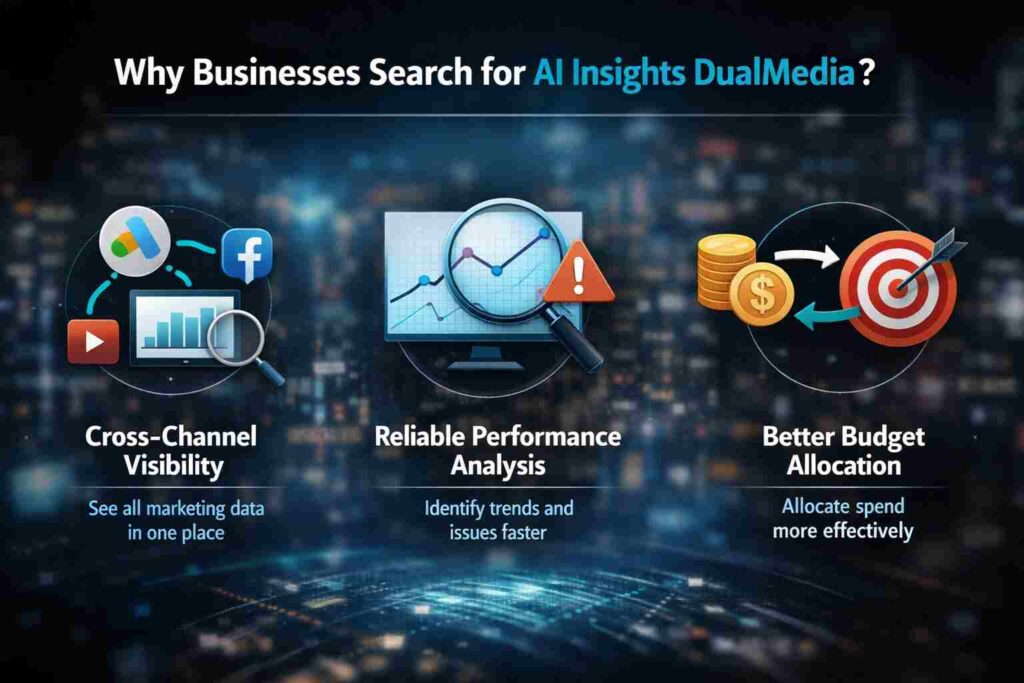
There is a clear business reason behind the keyword. Marketing teams want cross-channel visibility, more reliable performance analysis, and a better way to allocate spend.
Traditional reporting creates three common problems. First, teams overvalue the last-click channel and undercount assist channels. Second, reporting delays lead to slow decisions. Third, disconnected data creates false certainty.
AI Insights DualMedia addresses those issues by improving the quality of interpretation. It does not make marketing automatic. It makes decision-making more accurate when the underlying data is trustworthy.
This is where innovation news dualmedia can strengthen the article’s semantic relevance. The broader topic of AI innovation, analytics, digital transformation, and media intelligence supports the core keyword and signals topical authority.
Core Use Cases That Matter Most
The first major use case is budget allocation. If one channel is creating assisted conversions but looks weak in last-click reporting, a traditional team may cut spend in the wrong place. Ai insights dualmedia helps correct that mistake by using a broader performance view.
The second use case is creative analysis. AI can identify patterns in headlines, visuals, timing, and audience response faster than manual review. That helps teams find what is actually driving performance rather than relying on internal assumptions.
The third use case is audience and journey analysis. High-performing campaigns are rarely about one ad. They depend on sequencing, message alignment, and channel interaction. DualMedia becomes valuable when it helps teams see that journey with more precision.
The fourth use case is forecasting. Instead of reacting only after a campaign underperforms, businesses can use predictive modeling to adjust early. That is where AI creates operational value.
Benefits You Can Realistically Expect
The first benefit is speed. Teams can respond faster because the insight layer reduces reporting delays and surfaces problems earlier.
The second benefit is better attribution clarity. It will not eliminate ambiguity, but it can improve channel evaluation by combining multiple signals instead of trusting one platform’s self-reported view.
The third benefit is smarter use of first-party data. That is increasingly important as privacy regulation, consent limitations, and tracking loss continue to reshape performance measurement.
The fourth benefit is more disciplined optimization. Good AI systems reduce guesswork. They do not remove strategy, but they improve the evidence behind it.
The Missing Truth Competitors Usually Avoid

Most pages about ai insights dualmedia focus too heavily on upside. They talk about AI, automation, and optimization but ignore the factor that determines whether the model produces useful outputs.
The real dependency is data readiness.
If the CRM is incomplete, if UTM naming is inconsistent, if offline conversions are missing, or if tracking is broken, the insight model becomes weaker. The AI layer may still generate recommendations, but those recommendations will be less reliable.
That is the strongest information gain angle on this topic. The limiting factor is often not the AI. It is measurement quality, governance, and data hygiene.
| Factor | Implementation-Ready Setup | Weak Setup Outcome |
|---|---|---|
| Tracking | Consistent conversion events across channels | Misleading signals |
| CRM Data | Accurate lead and revenue mapping | Poor audience intelligence |
| Attribution | Defined model and reporting rules | Wrong budget decisions |
| Taxonomy | Standard naming conventions | Fragmented analysis |
| Governance | Human review and QA process | Automation errors |
This table gives users something most competing pages do not: a practical checkpoint before adoption.
AI Insights DualMedia vs Traditional Reporting
Traditional reporting is usually reactive, channel-specific, and manual. It explains the past, often with delays.
AI Insights DualMedia is designed to be cross-channel, predictive, and action-oriented. It improves the ability to spot waste, identify growth opportunities, and understand how channels work together.
That does not mean AI replaces people. It means human decisions become stronger when supported by better evidence. The best-performing teams still apply judgment. They simply do it with cleaner inputs and faster insight loops.
How to Implement It Without Wasting Budget
Start with a measurement audit. Verify GA4 events, CRM fields, attribution rules, naming conventions, and channel integrations before deploying advanced reporting logic.
Then launch a controlled pilot. Use one segment, region, or campaign category. Define KPIs in advance, such as cost per qualified lead, assisted conversion value, return on ad spend, or sales velocity.
After that, build a governance layer. Review AI recommendations weekly, confirm data integrity, and document what changed performance. This is where DualMedia becomes operational rather than theoretical.
If you publish supporting content around innovation news dualmedia, link it to implementation, trust, data strategy, and ROI. That helps build a topical cluster instead of a single isolated article.
Is AI Insights DualMedia Worth It?
Yes, when a business has usable first-party data, stable tracking, and a team capable of acting on insights. No, when leadership expects AI to fix broken measurement.
That is the direct answer users need. Ai insights dualmedia can improve performance visibility, budget decisions, and optimization speed. But it is not a shortcut around weak infrastructure.
The pages most likely to win on this keyword will do more than define the term. They will explain how dualmedia fits into a wider AI and analytics framework, where innovation news dualmedia supports context, and where performance depends on the quality of the data underneath the model.
FAQs
What is AI Insights DualMedia?
It is an AI-driven media intelligence approach associated with DualMedia that combines analytics, attribution, and predictive insights to improve marketing decisions.
Is AI Insights DualMedia a software product?
It is better understood as a strategy and operating model, though it may involve several tools, dashboards, and integrations.
Who benefits most from ai insights dualmedia?
Businesses running multi-channel campaigns benefit most, especially those with CRM data, paid media, and clear conversion tracking.
What is the biggest implementation risk?
The biggest risk is poor data quality. Broken tracking and weak CRM structure reduce the value of every insight.
