


If you want predictable organic growth, you can’t treat content like isolated blog posts. Your Topics Multiple Stories is a way to turn each core topic into a structured system of pages that answer different questions, match different intents, and support each other through measurable internal relationships. The goal is not “more content.” The goal is better coverage, cleaner measurement, and fewer wasted pages.
- Why “One Topic” Needs “Multiple Stories”
- Start With a Measurement-Ready Topic Model
- Design “Stories” With Intent, Not Just Keywords
- Build a Data Loop Before You Publish
- Architect Pages to Work Together
- Use Briefs That Encode Decisions
- Publish, Test, and Refresh Without Guesswork
- Quality Guardrails That Keep You Google-Friendly
- Conclusion
- FAQs
Why “One Topic” Needs “Multiple Stories”
A single topic rarely maps to a single search behavior. People search with different goals (learn, compare, decide, troubleshoot), at different levels of expertise, and with different constraints. “Multiple stories” means you deliberately create several angles around the same topic—each with a clear purpose, audience, and success metric—so your site earns relevance across the full journey.
This approach also reduces fragmentation: instead of ten disconnected posts competing for the same terms, you build an ecosystem that consolidates relevance and links.
Start With a Measurement-Ready Topic Model

Before writing, define a topic model that you can track over time. Think in three layers:
Topic → Subtopics → Query Families
- Topic: the broad area you want authority in.
- Subtopics: the key parts of that area (features, use cases, problems, constraints).
- Query families: groups of searches that share the same outcome and expectations.
This is where topic cluster strategy becomes practical: clusters aren’t a buzzword, they’re a way to control scope and measurement at the same time. Build a map that ties each planned page to an intent, a target audience, and a single primary outcome.
Design “Stories” With Intent, Not Just Keywords
Create an intent matrix for each topic. One topic can generate multiple story types:
Common Story Types That Scale
- Explainers: define concepts and reduce confusion.
- How-to workflows: step-by-step execution.
- Decision support: comparisons, checklists, and evaluation logic.
- Diagnostics: troubleshooting and edge cases.
- Proof and methodology: how results are measured, what “good” looks like.
This is where search intent clustering helps: you group queries by what the searcher expects to see, not by superficial word overlap. If you ignore intent, you’ll publish pages that look different but perform the same—and cannibalize each other.
Build a Data Loop Before You Publish
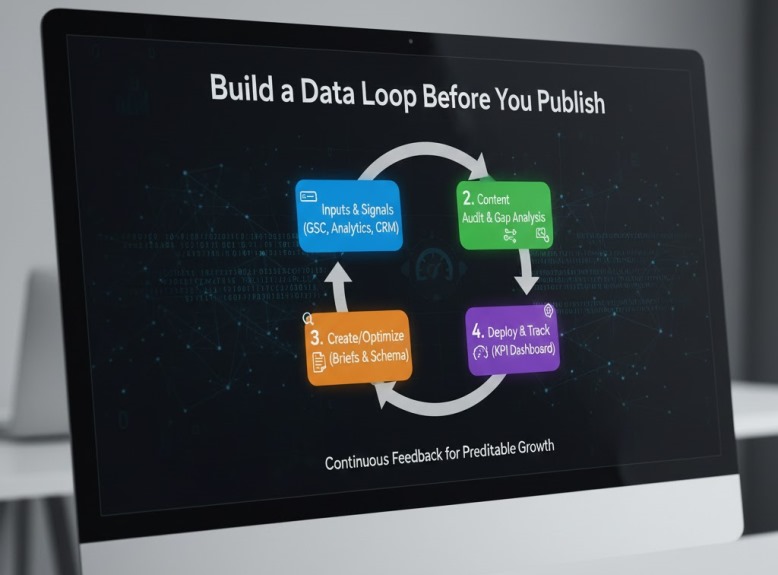
Data-driven content is not “write, then hope.” Set up a lightweight pipeline:
Minimum Viable Inputs
- Search queries and pages: from a Google Search Console content strategy view (queries → pages → performance trend).
- Site behavior: time on page, scroll depth, assisted conversions (where available).
- Business signals: sales objections, support tickets, onboarding friction, churn reasons.
Run a content audit checklist quarterly to identify what should be kept, merged, rewritten, or retired. Then run content gap analysis at the topic level—compare what your site covers versus what your audience repeatedly asks, and what the SERP consistently rewards.
Real-World Data Snapshot: Less Cannibalization, Longer Dwell Time
Below is a small before/after snapshot from a B2B SaaS niche (analytics dashboards) where one topic was reorganized into multiple intent-based “stories” (definition page + workflow guide + troubleshooting page + decision checklist), then connected with deliberate internal links and clarified page intent to prevent overlap.
| Metric (Topic Cluster: “Dashboard Reporting”) | Before (8 overlapping posts) | After (1 pillar + 6 intent pages) | Change |
|---|---|---|---|
| Cannibalization incidents (same keyword triggering 2+ URLs / month) | 14 | 3 | -78% |
| Avg. dwell time (cluster pages) | 1:12 | 2:05 | +74% |
| Pages per session (landing within cluster) | 1.3 | 1.9 | +46% |
| Organic clicks (cluster total) | 1,020 | 1,310 | +28% |
Architect Pages to Work Together
The “multiple stories” approach only becomes “authority” when the pages connect logically.
Choose Your Structure Deliberately
Decide on the relationship between summary and depth. The best structure is the one that matches your topic and resources, but you must be explicit about pillar page vs topic cluster so writers don’t guess.
Link With Purpose, Not Randomly
Build internal linking for topic clusters based on user progression:
- From definitions → how-to
- From how-to → troubleshooting
- From troubleshooting → decision support
- From decision support → implementation templates
Each internal link should answer, “What will the reader need next?” not “Where can I add another link?”
Also Read: Internet Chicks: Defining Their Identity and Digital Power
Use Briefs That Encode Decisions
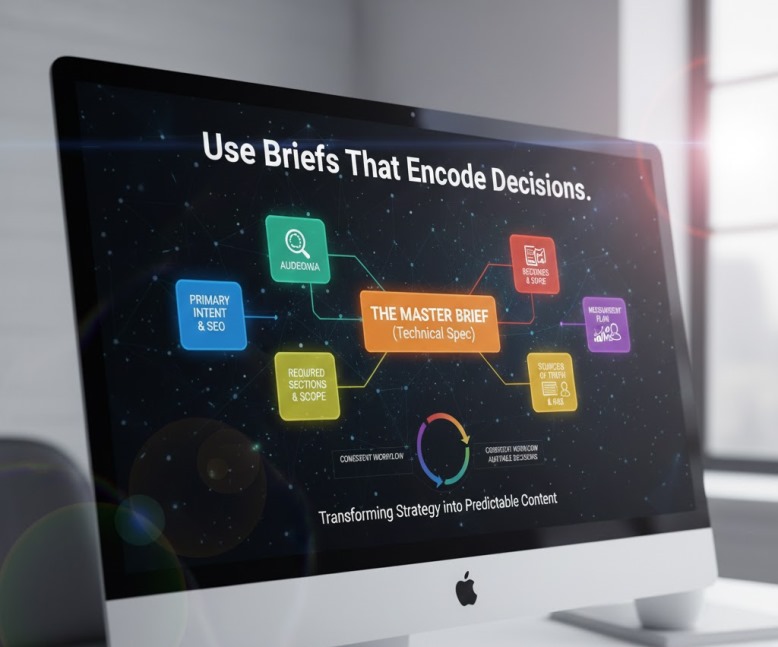
Your content brief should function like a technical spec:
- Primary intent and secondary intent (allowed, but controlled)
- Audience level (beginner, practitioner, expert)
- Required sections and exclusions (what NOT to cover)
- Sources of truth (docs, policies, product behavior)
- Measurement plan (KPIs and time window)
If your team ships content at scale, define a content operations workflow so research, writing, review, and updates are consistent and auditable.
Publish, Test, and Refresh Without Guesswork
SEO performance changes over time. Don’t “set and forget.”
Watch for Decline Signals
Track topic-level trends and page cohorts to catch content decay SEO early—before rankings slide far enough that recovery becomes expensive. A practical rule: if impressions hold but CTR drops, review titles/snippets; if impressions fall, re-check intent match and coverage.
Refresh With a Hypothesis
A content refresh strategy should be tied to one diagnosis:
- Intent mismatch → restructure sections and examples
- Coverage gaps → add missing sub-answers
- Weak credibility → tighten methodology, add definitions, clarify constraints
- Thin differentiation → add workflows, decision rules, or pitfalls
Measure impact with an SEO KPI dashboard that separates leading indicators (impressions, average position distribution, internal link flow) from lagging outcomes (leads, trials, qualified demos). When possible, evaluate content ROI measurement cautiously: attribute results using ranges and assisted paths rather than pretending content has a single-cause conversion.
Quality Guardrails That Keep You Google-Friendly
To stay durable:
- Avoid exaggerated promises and unverifiable claims.
- Use consistent terminology and definitions across the cluster.
- Make updates visible (last reviewed date, change notes when appropriate).
- Merge overlapping pages instead of publishing “near-duplicates.”
Conclusion
Your Topics Multiple Stories works when you treat each topic like a managed product: mapped by intent, built on measurable inputs, connected through purposeful architecture, and maintained through disciplined refresh cycles. This is an advanced strategy, but it’s also practical—because it reduces waste, improves clarity, and makes performance diagnosable instead of mysterious.
FAQs
1) How do I adapt this strategy for multilingual sites without duplicating effort?
Build one master topic map/brief and localize by search intent and local SERPs (not literal translation), using correct hreflang.
2) What is a safe review process when multiple teams (SEO, legal, product) must approve content?
Use a single workflow with required sign-offs in order: SEO → Product accuracy → Legal/compliance → Editor final.
3) How can I prioritize topics when search data is limited for a new market or new product category?
Prioritize topics from real customer questions and product friction, publish core pages, then expand using early Search Console signals.
