

A random character generator is a practical tool for creating secure, unpredictable strings from letters, numbers, and symbols. It is used for everything from passwords, API tokens, and session IDs to database testing and cartoon character ideas. This guide explains how PRNGs, TRNGs, and cryptographic randomness work, and why strong randomness matters for modern cybersecurity in everyday backend systems today.
- What Is a Random Character Generator?
- How Does a Random Character Generator Work?
- PRNG vs TRNG: The Engine Behind Random Strings
- Why Cryptographic Randomness Matters in Cybersecurity
- Key Backend Uses
- Random Cartoon Character Generator vs Security Generator
- How to Choose the Right Character Randomizer
- Conclusion
- FAQs
What Is a Random Character Generator?
A random character generator is a simple tool that generates a new string from letters, numbers, or symbols – or a mixture of all three. It can be used for a random username, a funny cartoon character name, a test ID or a secure-looking access code.
It uses a pre-defined set of characters to generate a string of selected size in the background. The concept is simple, but the good or bad of the quality is based on the randomness of what is produced. If the character randomizer is used for casual use, virtually any character randomizer will do. The generator should generate the random value with strong, unpredictable randomness for passports, API tokens, salts, or session IDs.
How Does a Random Character Generator Work?
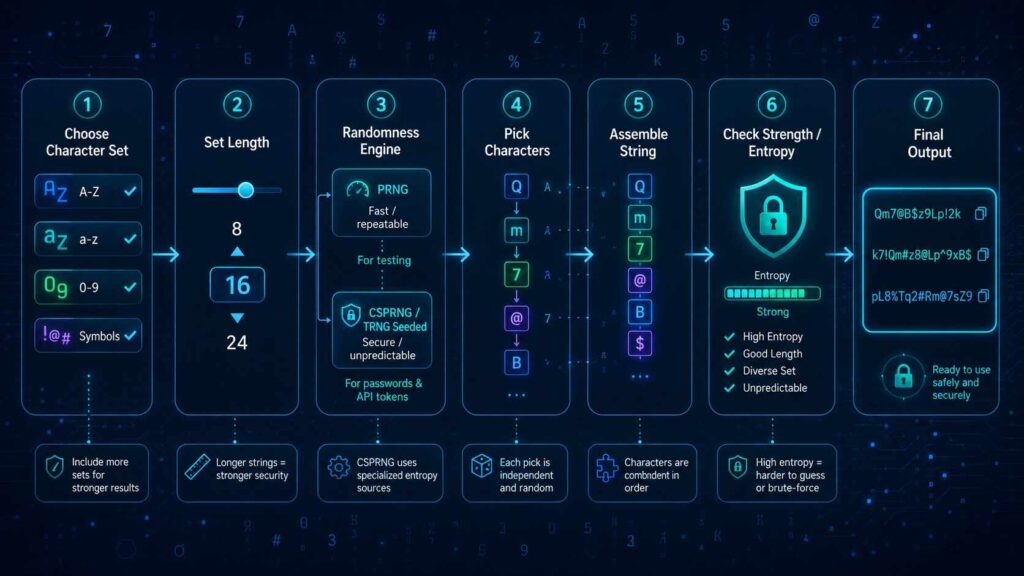
Most generators follow three steps: define the allowed characters, set the length, and use an algorithm or entropy source to choose each character.
For example, an alphanumeric random string generator may create a 20-character coupon code, test ID, or access key. A secure random password generator may include symbols to make guessing harder.
Longer strings are usually stronger, but length alone is not enough. If the algorithm is predictable, the output can still be weak. That is where PRNG and TRNG matter.
PRNG vs TRNG: The Engine Behind Random Strings
PRNG: Fast, repeatable, and useful for testing
A PRNG, or pseudo-random number generator, uses a formula and a starting value called a seed. If the same seed is used again, the same sequence can appear again.
That repeatability helps with database QA testing, simulations, games, and debugging. A USA-based ecommerce team, for example, may need thousands of fake order IDs, SKUs, and usernames. A seeded character randomizer helps recreate the same test data.
A normal PRNG should not be used for private API keys, reset links, or login tokens because predictable output can create security risk.
TRNG: Randomness from real-world events
A TRNG, or true random number generator, gathers randomness from physical sources such as hardware noise, electrical behavior, or atmospheric noise. These sources are harder to predict than a standard software formula.
Many secure systems use real-world entropy to seed a cryptographically secure random generator. This gives backend applications strong randomness without slowing every request.
Why Cryptographic Randomness Matters in Cybersecurity

A random cartoon character generator can be playful. A backend API token generator cannot. If attackers guess a token, session ID, or password reset link, they may access accounts or private data.
Cryptographic randomness protects identity and access. It is used for password hashing salts, API tokens, bearer tokens, session cookies, CSRF tokens, nonces, email verification links, and temporary access codes.
The practical rule is simple: use regular PRNGs for repeatable testing, but use a cryptographically secure random string generator for authentication, authorization, encryption, or anything linked to user identity.
Key Backend Uses
Password hashing salts
Secure systems should not store plain passwords. They store password hashes. A random salt is added before hashing so two users with the same password do not create the same stored hash. For this job, the generator must be secure, unique, and hard to predict.
API token creation
API tokens work like digital keys. SaaS platforms, internal dashboards, and mobile apps use them to control access. A good API token is long, high-entropy, created on the server side, and stored safely.
Database QA testing
QA teams use random strings to test forms, billing flows, usernames, coupon codes, product SKUs, and sample comments. Here, repeatability may matter more than secrecy. A seeded PRNG is useful, but test generators should never be reused for real credentials.
Random Cartoon Character Generator vs Security Generator
A random cartoon character generator is built for creativity. It may create names, powers, colors, outfits, and personality traits. A cartoon character generator helps writers, teachers, game designers, and kids brainstorm quickly.
A security-focused random character generator has a different goal. It does not need to sound nice or memorable. It needs entropy, length, and unpredictability. “MiloSky77” may work as a random character name, but it is weak for an admin token or password reset link.
Also Read: Acoustic Data Exfiltration: Coding Air-Gap Networks
How to Choose the Right Character Randomizer
Choose based on risk. For creative projects, look for theme controls and fun output styles. For QA testing, look for bulk generation, exports, custom formats, and seed support. For cybersecurity, look for cryptographic randomness, strong alphanumeric output, symbol support, and server-side generation.
Avoid tools that create very short strings, reuse patterns, expose results in browser history, or claim “unbreakable security” without explaining how randomness is produced.
Conclusion
A random character generator can support creative writing, software testing, and serious cybersecurity. PRNGs are best for repeatable testing, while TRNGs and cryptographically secure generators are better for passwords, salts, API tokens, nonces, and session IDs.
Before choosing a tool, decide what the string must protect. For your next step, read a related guide on secure password generation, API token best practices, or database testing workflows.
FAQs
What is a random character generator used for?
It creates random letters, numbers, symbols, names, passwords, tokens, test IDs, coupon codes, and database sample values.
Is a PRNG safe for API tokens?
A standard PRNG is not recommended for API tokens. Use a cryptographically secure generator designed for secrets and authentication.
Can I use a random character generator for passwords?
Yes, but only when it uses cryptographic randomness. Avoid simple or predictable generators.
