


Have you ever noticed AI writing that looks fine at first glance but still feels off? The sentences may be correct, yet the tone is out of place. That is why AI to human text converter tools have become so popular. They help rewrite stiff, mechanical output into language that sounds natural and organic, closer to how people actually write. We break down the top five tools that do this best and explain which options turn AI text into something that truly passes as human-written.
How We Selected the Best AI Humanizers
To make this comparison meaningful, we ran hands-on tests instead of relying on marketing claims or demo samples. Many of the tools we evaluated frequently appear in Reddit threads. In addition, a large number of people specifically look for free solutions, as reflected in this open discussion on humanizing, so we paid special attention to tools that offer a free tier or allow meaningful testing without payment.
In total, we tested 26 different tools using six separate texts with different purposes, including an academic essay, a long-form article, a blog post, and other common content types.
Here is what we evaluated in each case:
- We started with output quality. Each tool had to break predictable sentence patterns, vary rhythm, and use wording that feels normal in real content creation. Tools that kept a neutral tone, repeated the same structures, or felt overly polished ranked lower. This also included extensive grammar check with online tools like Grammarly and a manual review from our expert.
- We know how important this is for many people, especially for students, to bypass AI detection. So we tested the humanized results across multiple AI detectors to see how well they can reduce AI percentages. These included GPTZero, ZeroGPT, Originality.ai, Grammarly, Undetectable AI, and Copyleaks. This step helped us see which tools only sound better to a human reader and which ones actually reduce detection signals.
- Practical use mattered just as much. We checked how well each humanizer works with different text lengths and formats, from short paragraphs to longer articles. We also tested how well they humanize output from different AI models, including GPT-based text and Claude-generated content, to see whether the results stay consistent across sources. Reliable output and ease of use carried more weight than flashy features.
- Beyond basic performance, we considered pricing and extra features such as tone controls, editing history, API access, and batch processing. Tools that offered flexible plans, clear value, and useful add-ons scored higher, since reliable output and ease of use carried more weight than flashy features alone.
After testing different tools, we selected only five for this list, the ones that showed the strongest overall performance in our evaluations.
Also Read: Best AI Search Engine: Top 5 Picks for 2026 (Ranked)
Top 5 Best AI Humanizer Tools
Each tool in our list earned its place by excelling in at least one practical use case, from academic writing and content creation to quick readability improvements.
Here are the best tools to rewrite AI text to pass as human-written:
| Tool | Best For | AI Detection Test Results | Strengths | Weaknesses |
| Clever AI Humanizer | All-around humanization, long texts, free use | Reduced AI scores from 100% → 0–4% on GPTZero, ZeroGPT, Originality.ai, Copyleaks | Natural and polished output, stable grammar, works across AI models, large free limits, includes AI Writer, Grammar Checker, Paraphraser | Fewer advanced tone controls than paid tools |
| WriteHuman AI | Quick AI detection reduction | Initial results dropped to 0–5% AI, but increased sharply after Grammarly correction | Built-in AI detector, supports GPT, Claude, Gemini, high word limits on paid plans | Free version very limited, relies partly on human-like imperfections |
| GPTHuman AI | Academic tone control and readability | GPTZero 100% → 8% AI, Grammarly 62% → 0% AI, Undetectable AI 99% → 62% AI | Clean output, multiple academic levels, multi-language support, content generation | Mostly surface-level rewriting, struggles with advanced detectors |
| Ahrefs AI Humanizer | Light rewriting and readability | Minimal improvement, often 50–70% AI or 100% AI on strict detectors | Completely free, fast, integrates with Ahrefs tools | No meaningful AI detection bypass, very limited semantic change |
| HIX Bypass Humanizer | Maximum text transformation | Inconsistent results, 55–60% AI on lighter detectors, 100% AI on Originality.ai | Aggressive rewriting, many languages, multiple rewrite modes | Grammar and readability issues, unreliable against advanced detectors |
1. Clever AI Humanizer
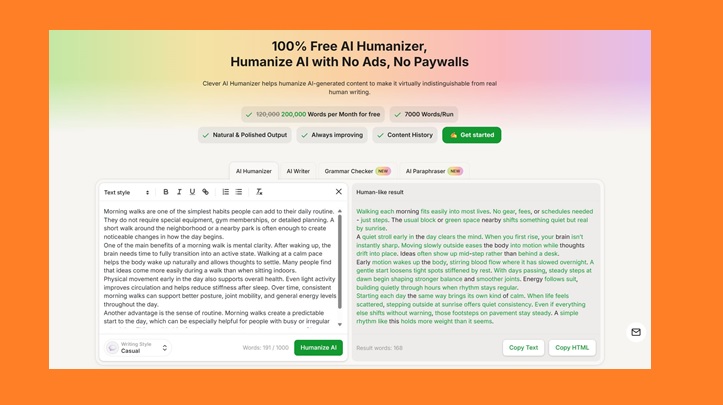
Pros
- 100% free with no paywalls or ads
- Large free limits, 200,000 words per month and 7,000 per run
- Natural and polished output
- Stable grammar quality
- Content history included
- Works well across different AI models
- Includes AI Writer, Grammar Checker, and Paraphraser
Cons
- Fewer advanced controls than some paid tools
Clever AI Humanizer is one of the strongest free AI to human text converter tools. It can remove common AI writing patterns without aggressively swapping words or injecting awkward phrasing. The result usually feels natural and suitable for real publishing, not just detector tests. It works well for essays, blog posts, emails and articles, and it handles longer texts better than many free alternatives.
Beyond the humanizer itself, Clever also includes several useful extras to write and humanize AI content. An integrated AI Writer allows users to generate already humanized texts. The built-in Grammar Checker helps clean up minor issues before publishing, and the Paraphraser offers an alternative way to refine text without changing its meaning too much. These tools add real value, especially for users who want an all-in-one workflow.
In our tests, Clever AI Humanizer produced consistently readable output across all six test texts. Sentence flow improved noticeably, repetitive structures disappeared, and the tone felt closer to how a human editor would revise the text. Grammar quality remained stable, with no obvious errors introduced, which we confirmed through Grammarly checks and manual review.
When processing this humanized content through AI detectors like GPTZero, ZeroGPT, Originality.ai, and Copyleaks, the outcomes proved impressive. In most cases, AI detection scores dropped clearly compared to the original text, from 100% AI to 0-4%.
2. Write Human AI
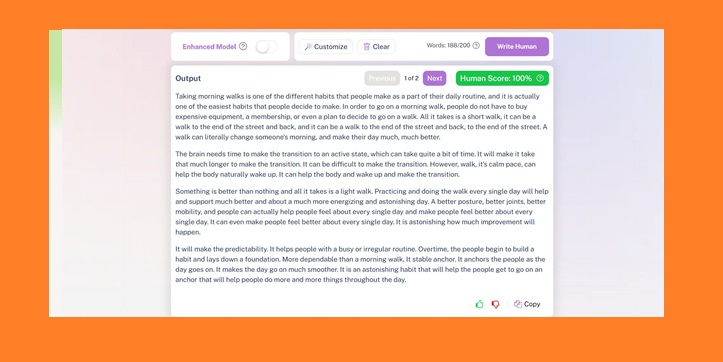
Pros
- Strong initial AI detection reduction
Built-in AI detector - Works with text from GPT, Claude, Gemini, and others
- Clean and easy interface
- Paid plans offer high word limits
Cons
- Free version very limited (300 words)
- Detection results rely partly on minor errors
- AI scores increase after grammar correction
- Limited control over tone and style
WriteHuman AI is an AI humanizer with a strong focus on AI detection performance. Unlike many free tools, it combines text humanization with a built-in AI detector and offers an “Enhanced Model” for paid users. The interface stays simple, and the workflow suits users who want quick results without manual tweaks.
In practical tests, WriteHuman showed mixed but interesting behavior. On the surface, the humanized text often achieved very low AI scores across detectors such as GPTZero, QuillBot, Originality.ai, and Copyleaks. In several cases, the initial output scored close to 0% AI, which looks impressive at first glance.
However, a closer review revealed an important detail. WriteHuman often reduces AI detection by introducing small imperfections that resemble human mistakes. When we ran the output through Grammarly and applied all suggested corrections, AI detection scores increased sharply across most detectors. Originality.ai and GPTZero showed the largest jumps. This indicates that detection bypass relies partly on controlled imperfections rather than deeper structural rewriting.
3. GPTHuman AI
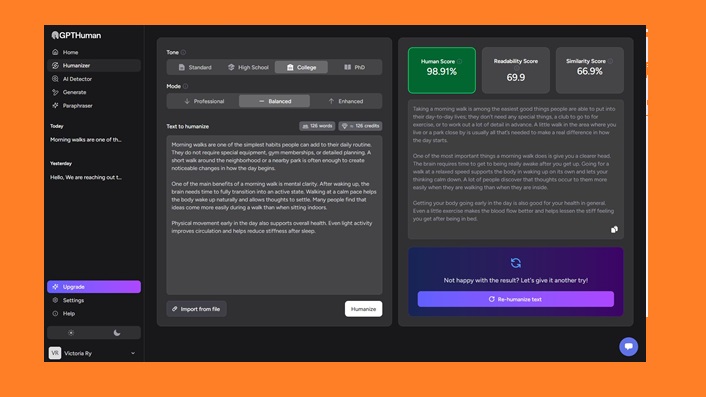
Pros
- Clean and readable output
- No reliance on grammar errors
- Multiple tone and academic level options
- Supports many AI models and languages
- Includes content generation and AI detection
Cons
- Struggles with advanced AI detectors
- Changes stay mostly surface-level
- Free version very limited
- Higher pricing than many competitors
GPTHuman AI markets itself as an all-in-one text converter built for students, writers, and SEO professionals. The tool combines humanization, content generation, and AI detection in one platform. It supports text from major AI models such as ChatGPT, Claude, Gemini, and others, and offers multiple tone levels, including academic modes like College and PhD.
In practical tests, GPTHuman improved readability and tone, but the changes stayed mostly on the surface. The humanized text sounded smoother and more conversational than raw AI output, especially for essays and blog-style content. Sentence flow improved, but semantic variation remained limited, meaning the structure and ideas often stayed close to the original AI draft.
AI detection results were clearly mixed. On lighter detectors, the drop was significant. GPTZero flagged the original text as 100% AI, which fell to 8% AI after humanization. Grammarly’s AI detector dropped from 62% AI to 0% AI, which looks strong at first glance. However, more advanced tools told a different story. Undetectable AI still flagged the content at 62% AI, down from 99% AI, but far from human-written.
4. Ahrefs AI Humanizer
Pros
- Completely free
- Easy to use and fas
- Slight readability improvement
- Integrates well with Ahrefs’ content tools
Cons
- No meaningful AI detection bypass
- Very limited semantic rewriting
- Not suitable for academic or high-risk detection scenarios
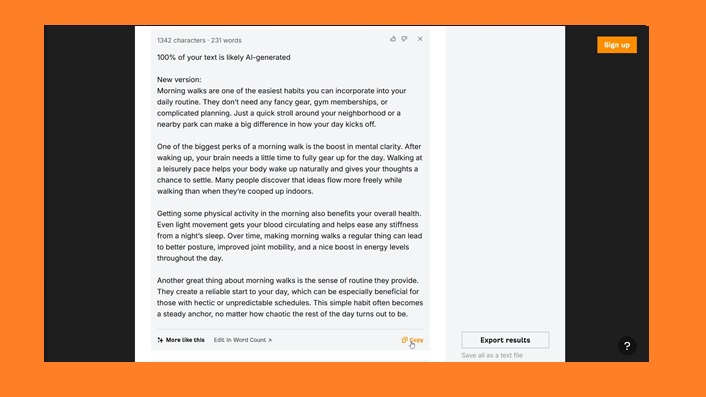
Ahrefs AI Humanizer is a free tool released by Ahrefs as part of its broader content toolkit. It claims to turn AI-generated text into more natural, human-like writing, mainly for content creators, marketers, and bloggers. Unlike most tools on this list, Ahrefs does not explicitly position its humanizer as an AI detection bypass tool, but the promise of “human-like” output makes detection performance an obvious point of interest.
In practical tests, the tool made only light stylistic changes. The rewritten text looked slightly cleaner and more readable, but sentence structure, phrasing, and overall flow stayed very close to the original ChatGPT output. The changes felt closer to basic rewriting than true humanization, with minimal semantic variation. Which affected detection scores, even on less strict detectors, the improvement was minimal – 50-70% AI.
5. Bypass.hix Humanizer
Pros
- Aggressive rewriting compared to lighter tools
- Supports many languages
- Includes built-in AI detection
- Multiple rewrite modes
Cons
- Fails against advanced detectors (100% AI on Originality.ai)
- Frequent grammar and readability issues
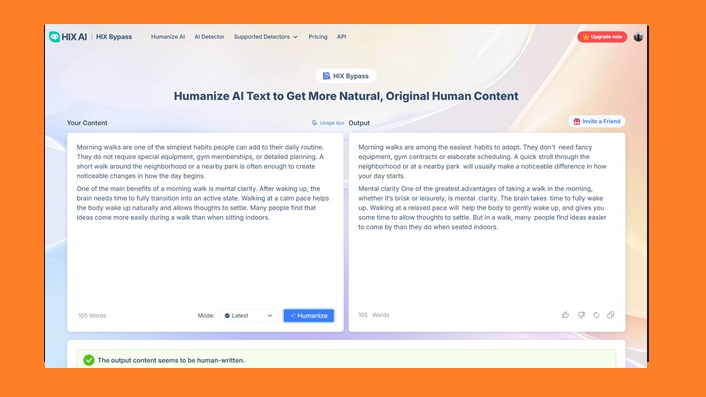
HIX Bypass is one of the most aggressively marketed AI humanizers on the market. It promises a 99–99.5% success rate, claims guaranteed bypass of premium AI detectors, and positions itself as a solution for students, SEO specialists, and content creators who need AI text to pass as human-written. On paper, it looks powerful. Our tests tell a more complicated story.
In terms of surface output, HIX Bypass rewrites text much more heavily than tools like Ahrefs or GPTHuman. Sentence structure changes noticeably, phrasing becomes less predictable, and the text often looks different enough from the original AI draft.
However, this comes at a cost. In multiple samples, readability dropped, with awkward phrasing and grammar issues appearing after humanization.
AI detection results were inconsistent, especially when tested against stricter detectors. Originality.ai flagged HIX Bypass output as 100% AI in multiple independent tests. Copyleaks also marked the content as AI-written. Some lighter detectors showed improvement to 55-60% AI.
How to Make AI Text Sound More Human
Even strong AI tools often produce text that feels slightly off. To fix it, you can use a few useful tricks that can make your writing sound less robotic:
- Word choice also plays a big role. AI tends to rely on safe, predictable phrases that sound technically correct but emotionally flat. When you replace generic expressions with more specific or familiar wording, the text feels more organic. This does not mean you should add slang everywhere, but rather select words people actually use in real conversations or writing.
- Another important step is breaking perfect structure. Human writers do not always follow textbook formatting. Occasional fragments, softer transitions, or slightly informal phrasing make the text feel less engineered and more natural. Overly polished paragraphs often raise more red flags than slightly imperfect ones.
- Context awareness matters as well. AI text often repeats ideas or overexplains simple points. When you trim redundant sentences and trust the reader, the flow improves and the content feels more confident. Humans usually imply ideas rather than restate everything explicitly.
- AI writing also tends to stay overly neutral and lacks substance. It avoids clear stances and concrete details such as numbers or specific situations. Human writing usually adds context and tangible details, and it implies ideas rather than restates everything explicitly. To fix this, add specific cases or brief data points where they make sense, and double-check everything you include, since AI can hallucinate facts or figures.
- Finally, reading the text out loud helps more than any tool. If a sentence sounds unnatural when spoken, it likely needs adjustment. Small edits like reordering words or simplifying phrasing can dramatically change how human the text feels without altering its meaning.
Humanizing AI text does not require a complete rewrite. A few targeted adjustments often make the biggest difference: more natural word choices, less rigid structure, clearer intent, and concrete details that add substance.
Final Verdict
After testing 26 tools across six real-world text types and multiple AI detectors, each solution showed its own strengths depending on the use case. Clever AI Humanizer delivered the most consistent balance of natural tone, stable grammar, and reliable performance across different AI models, which makes Clever AI Humanizer our pick for best AI humanizer overall. At the same time, tools like WriteHuman impressed with strong initial AI score reductions, GPTHuman AI offered flexible tone control and academic modes, Ahrefs AI Humanizer worked well for light rewrites and readability improvements, and HIX Bypass provided aggressive rewriting options for users who prioritize maximum transformation.
