

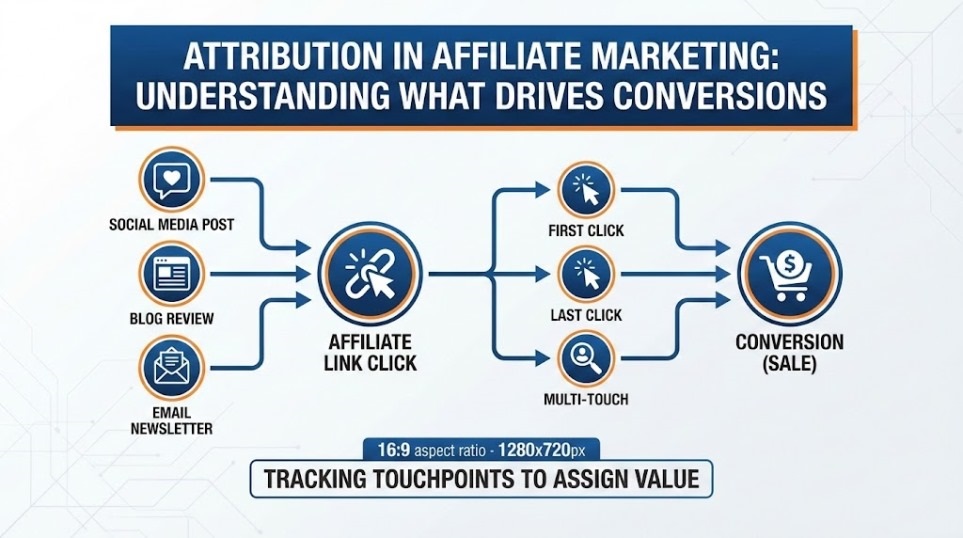
Affiliate marketing is built on partnerships, trust, and measurable performance. Brands rely on affiliates – content creators, publishers, and influencers — to drive traffic and generate sales. But when multiple channels and touchpoints contribute to a conversion, one critical question arises: who deserves the credit?
That’s where attribution comes in. Attribution in affiliate marketing is the process of identifying and assigning value to each step in the user journey that leads to a desired action, such as a purchase or signup.
Without a clear attribution model, it’s impossible to evaluate performance accurately, reward affiliates fairly, or optimize campaigns effectively. Modern advertising platforms like MGID, which specialize in performance-based and native advertising, provide transparent data and advanced tracking tools that help marketers solve this challenge with precision.
What Is Attribution in Affiliate Marketing?
Attribution refers to the method used to determine which affiliate or channel influenced a conversion event.
For example, a user might:
- Read a product review on an affiliate blog,
- See a retargeting ad on a native advertising platform like MGID,
- And finally click a coupon link on another site before completing the purchase.
Which of these partners should earn the commission? Attribution models answer this by defining how much credit each touchpoint receives.
The goal is not just to reward affiliates but also to understand how different marketing activities work together to drive results.
Also Read: Icons8 Icons for App Builders: A Practical, Code‑First Review
Why Attribution Matters
Attribution plays a central role in every successful affiliate program because it affects:
- Affiliate payouts: Determines who gets compensated for each conversion.
- Budget allocation: Identifies which channels deserve more investment.
- Campaign optimization: Reveals which touchpoints actually influence customer decisions.
- Transparency and trust: Builds confidence among partners through data-driven fairness.
Without proper attribution, you risk overpaying for low-value traffic or undervaluing high-impact affiliates. In competitive markets, that can distort ROI and discourage collaboration.
Common Attribution Models
Different attribution models represent different philosophies about how to assign credit. The best choice depends on your business goals, sales cycle, and partner ecosystem.
1. Last-Click Attribution
The most traditional and widely used model. The last affiliate that referred the customer before the conversion receives 100% of the credit.
Pros: Simple and easy to implement.
Cons: Ignores earlier touchpoints that may have influenced the decision.
2. First-Click Attribution
In this model, the first affiliate interaction gets full credit.
Pros: Highlights discovery channels and awareness efforts.
Cons: Neglects the contribution of later nurturing or retargeting efforts.
3. Linear Attribution
Each interaction along the consumer’s path is assigned the same value.
Pros: Fair representation of all affiliates.
Cons: Can dilute the impact of stronger interactions.
4. Time-Decay Attribution
Gives more credit to recent interactions, under the assumption that the closer the click to the conversion, the greater its influence.
Pros: Reflects real-world purchase behavior.
Cons: Requires accurate time-stamped tracking data.
5. Position-Based (U-Shaped) Attribution
Splits credit between the first and last interactions, assigning smaller portions to the middle touchpoints.
Pros: Recognizes both awareness and conversion drivers.
Cons: More complex to configure and interpret.
6. Data-Driven or Algorithmic Attribution
Modern systems — including some performance platforms and analytics tools — use machine learning to assign credit dynamically based on observed behavior patterns.
Pros: Offers the most accurate reflection of customer journeys.
Cons: Requires advanced data infrastructure and large sample sizes.
Platforms like MGID often integrate with third-party tracking solutions or offer custom attribution logic to help advertisers match these models to their goals.
How Attribution Works in Practice
A robust attribution setup combines several components:
- Tracking Links & Cookies: Each affiliate receives a unique tracking link that identifies their traffic and actions.
- Postback URLs or Pixels: When a conversion occurs, data is sent back to the advertiser’s platform.
- Attribution Window: Defines the timeframe (e.g., 7 days or 30 days) during which conversions can be credited to an affiliate.
- Cross-Device Tracking: Ensures conversions are counted even when users switch between devices.
- De-Duplication Logic: Prevents multiple affiliates from claiming the same conversion unless intentionally allowed.
This infrastructure ensures accurate reporting, allowing both advertisers and affiliates to understand performance transparently.
The Role of Multi-Touch Attribution
Customer journeys have become increasingly non-linear. A single sale might involve several channels — organic search, social media, influencer content, and native ads — all influencing the decision.
Multi-touch attribution (MTA) acknowledges that reality. Instead of giving full credit to one source, it distributes value across multiple interactions.
Benefits include:
- A more complete picture of the buyer journey.
- Fairer affiliate rewards.
- Smarter campaign adjustments based on holistic data.
For example, if MGID’s native campaign introduces a user to a new product, and later an affiliate coupon closes the sale, MTA ensures both touchpoints receive appropriate value.
Challenges in Attribution
Despite its importance, implementing attribution effectively can be complex. Common challenges include:
- Cross-device behavior: Users often switch from mobile to desktop before converting.
- Cookie restrictions and privacy laws: Regulations like GDPR limit tracking capabilities.
- Data fragmentation: When analytics tools and affiliate networks don’t share information.
- Fraud and misattribution: Fake clicks or duplicated traffic can distort results.
To overcome these issues, advertisers rely on first-party data, server-to-server tracking, and anti-fraud systems. Performance platforms like MGID help mitigate risks by offering transparent traffic sources, real-time reporting, and fraud-prevention algorithms that validate conversions.
Optimizing Campaigns Using Attribution Insights
Attribution isn’t just about fairness — it’s a roadmap for optimization. Here’s how to use attribution data strategically:
- Identify High-Value Affiliates: Reward partners who consistently appear early or late in the conversion path.
- Adjust Bidding Strategies: Allocate budgets to affiliates or channels that generate high-quality conversions.
- Refine Creatives and Messaging: Analyze which touchpoints produce engagement spikes or drop-offs.
- Shorten Conversion Paths: Use insights to simplify user journeys and reduce friction.
- Test Different Attribution Windows: See how long users typically take to convert and adjust settings accordingly.
By continuously refining based on data, marketers can transform attribution models from static reports into dynamic optimization tools.
The Future of Attribution in Affiliate Marketing
As privacy standards evolve and tracking methods change, attribution is shifting toward contextual and first-party data models.
Emerging trends include:
- AI-driven attribution modeling that adapts in real time.
- Cookieless tracking through server-side and deterministic identifiers.
- Cross-channel integration between native, influencer, and content-driven campaigns.
- Predictive analytics to forecast conversion likelihood across affiliates.
Platforms like MGID are already integrating such innovations, combining AI optimization with performance transparency to ensure marketers understand not only what converted but why it did
Conclusion
Attribution is the backbone of effective affiliate marketing. It transforms raw data into actionable insights, ensuring that every partner, channel, and click receives fair recognition.
Whether through first-click, last-click, or advanced multi-touch models, attribution allows marketers to optimize campaigns, improve collaboration, and maximize ROI.
In a marketing world increasingly defined by complexity and accountability, transparent solutions like MGID empower advertisers to see the full picture — connecting every impression, click, and conversion into one clear narrative of success.
