
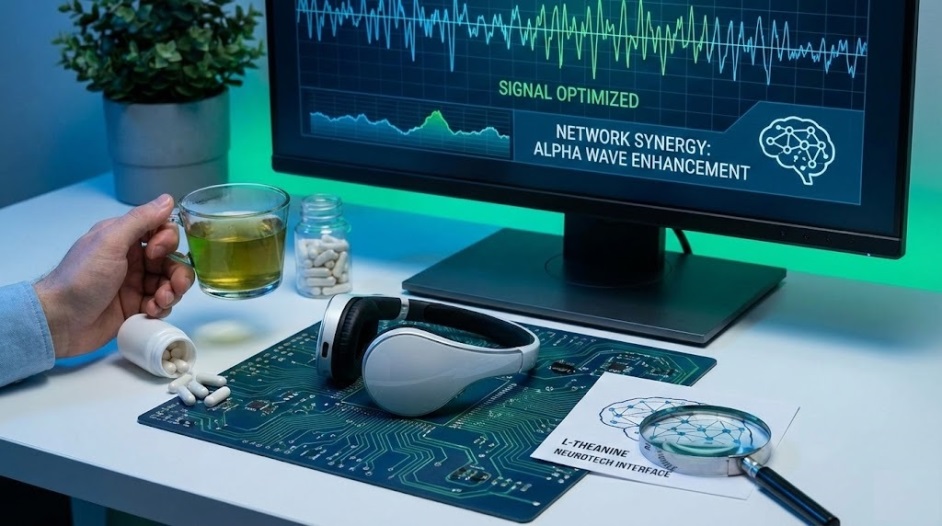
Caffeine can rapidly increase alertness, but it does not necessarily improve how brain networks coordinate or how readable those networks are to machines. L-theanine may contribute to that dimension. This amino acid from tea reliably produces a calmer, more stable attentional state in many controlled studies, with measurable effects on brain oscillations and network dynamics.
Here, we examine mechanisms, current human evidence, information‑theoretic findings, realistic neurotech integration, safety, and credible future directions—without treating speculation as established fact.
- What Is L-theanine, Really?
- Mechanisms: How L-theanine Talks to Your Brain
- From Nootropic to Neural Interface: Why It Matters for Neurotech
- Caffeine + L-theanine: The Classic Stack, Quantified
- Brain Networks, Information Theory, and L-theanine
- L-theanine as a “Neural Interface Optimizer” in Practice
- Dosing, Safety, and Constraints
- Bottom Line: Where the Evidence Actually Stands
- FAQs
What Is L-theanine, Really?
L-theanine is a non‑protein amino acid abundant in green and black tea and present in a few fungi. Structurally, it resembles glutamate, a primary excitatory neurotransmitter, which allows it to interact with glutamatergic systems and related receptors. After oral ingestion, L‑theanine is absorbed in the small intestine, crosses the blood–brain barrier, and reaches the brain within roughly 30–60 minutes, with acute effects lasting a few hours in most studies.
Human data associate L theanine with calm focus: reduced subjective stress and tension with preserved or slightly improved attention and working memory under load. Randomized controlled trials have reported decreased state anxiety and improvements in attentional switching and reaction time, especially in stress‑inducing or cognitively demanding contexts. However, effect sizes are generally small to moderate, and not everyone experiences noticeable changes, which is important for setting realistic expectations.
Mechanisms: How L-theanine Talks to Your Brain
Mechanistically, L-theanine exerts multi‑system, moderate actions rather than a single dominant pharmacological effect:
Glutamate and GABA balance
L-theanine can bind to glutamate receptors (including AMPA, kainate, and NMDA subtypes) as a weak antagonist or partial agonist in preclinical models, mildly dampening excessive excitatory signaling. Evidence also suggests it can increase brain GABA levels or GABAergic tone, gently shifting the excitation–inhibition balance toward stability and reduced hyperarousal.
Monoamine modulation
Animal studies and limited human data indicate modulation of dopamine, serotonin, and noradrenaline in regions such as the striatum, hippocampus, and prefrontal cortex. These changes likely contribute to improved stress resilience and mood under acute challenge. Still, chronic monoaminergic effects in humans remain insufficiently characterized and should not be treated as equivalent to established psychiatric medications.
Alpha‑wave enhancement
Multiple EEG studies show that L-theanine (typically 50–200 mg) increases alpha power (8–13 Hz) during relaxed wakefulness, often within 40 minutes of ingestion. Enhanced alpha is linked to relaxed alertness, internal focus, and suppression of irrelevant sensory input, aligning with reports of “cleaner,” less jittery focus.
Neuroprotection and plasticity
In vitro and animal work report antioxidant, anti‑inflammatory, and anti‑excitotoxic effects, including reduced glutamate‑induced neuronal injury and modulation of BDNF in some models. These findings support a plausible neuroprotective role, but long‑term clinical neuroprotection in humans has not been rigorously demonstrated.
Overall, L-theanine is best understood as a mild neuromodulator that shapes network state—shifting toward calm, stable alertness—rather than as a strong stimulant or sedative.
From Nootropic to Neural Interface: Why It Matters for Neurotech
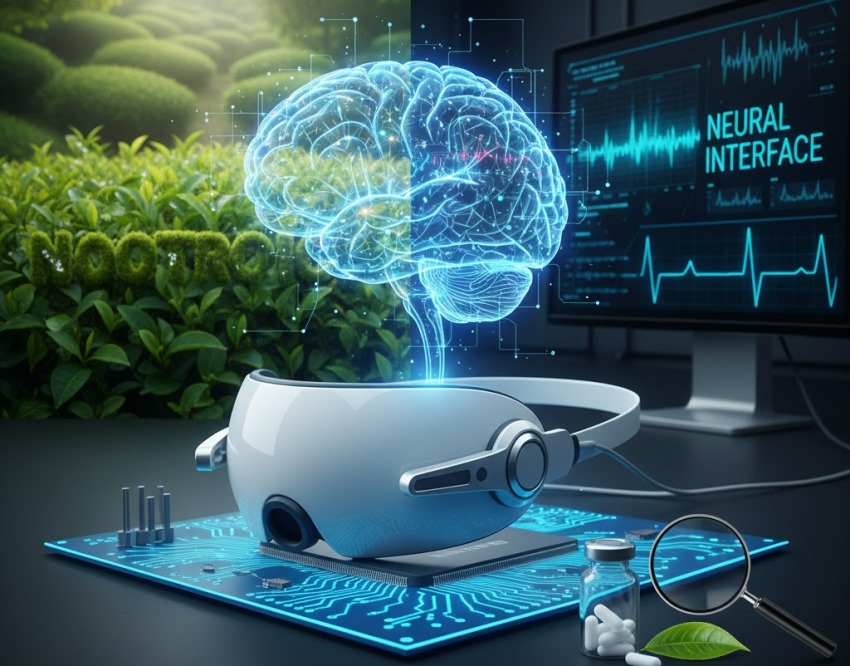
A neural interface is any system that reads, writes, or modulates brain activity through hardware and algorithms: EEG‑based BCIs, invasive electrode arrays, and neuromodulation systems such as TMS or tDCS. L-theanine does not replace these technologies, but it can serve as a biochemical context optimizer for them.
For EEG‑based BCIs and neurofeedback, three factors are critical: signal stability, signal‑to‑noise ratio, and user state control. Anxiety, muscle tension, micro‑movements, and inconsistent attention all degrade decoding accuracy and training efficiency. By reducing subjective stress, increasing alpha power, and stabilizing network excitation, L-theanine can, in principle, produce brain states that are more favorable for feature extraction and classifier performance.
This is not yet standard clinical practice, but it is a technically grounded hypothesis: if a compound reliably increases signal stationarity and lowers artifact‑driving arousal, it becomes a practical adjunct to neural interfaces rather than merely a “focus supplement.”
Also Read: Prokaryotes vs Eukaryotes: Key Cell Differences
Caffeine + L-theanine: The Classic Stack, Quantified
The caffeine–L-theanine stack is among the most empirically studied natural nootropic combinations. Meta‑analyses and controlled trials show that, compared with caffeine alone:
- Simple and choice reaction times are often improved or maintained.
- Accuracy in attention‑demanding tasks (for example, visual attention, task switching) is equal or better.
- Subjective jitteriness, mental fatigue, and tension are reduced in many participants.
- Performance benefits are most pronounced under sleep restriction, time pressure, or high task load.
Common research protocols use 50–150 mg caffeine with 100–250 mg L-theanine. The consistent pattern is not a huge performance leap but a better quality of stimulation: preserved or slightly enhanced cognitive performance with reduced side‑effect burden and more stable subjective state, which is exactly what BCIs and neurofeedback systems need.
Brain Networks, Information Theory, and L-theanine
Modern network neuroscience uses graph theory and information theory to quantify how brain regions cooperate. Beyond simple power spectra, measures such as functional connectivity, phase‑locking, and information‑theoretic indices capture higher‑order organization.
Metrics like Total Correlation, Dual Total Correlation, and O‑Information have been applied to EEG data under various cognitive states and pharmacological manipulations. Although published work explicitly combining L-theanine with these measures is still limited, early results and adjacent studies with caffeine–theanine and related compounds suggest:
- Increased large‑scale interdependence in task‑relevant cortical networks, reflecting stronger functional integration.
- Shifts toward greater synergy in low‑frequency and beta bands, implying that information carried by multiple channels becomes more integrated rather than redundantly duplicated.
- Substantial changes in internal network architecture that may exceed the magnitude of overt behavioral gains in simple tasks.
These findings support a plausible role for L-theanine as a network‑efficiency modulator—altering how information is distributed and integrated—rather than simply speeding responses.
L-theanine as a “Neural Interface Optimizer” in Practice
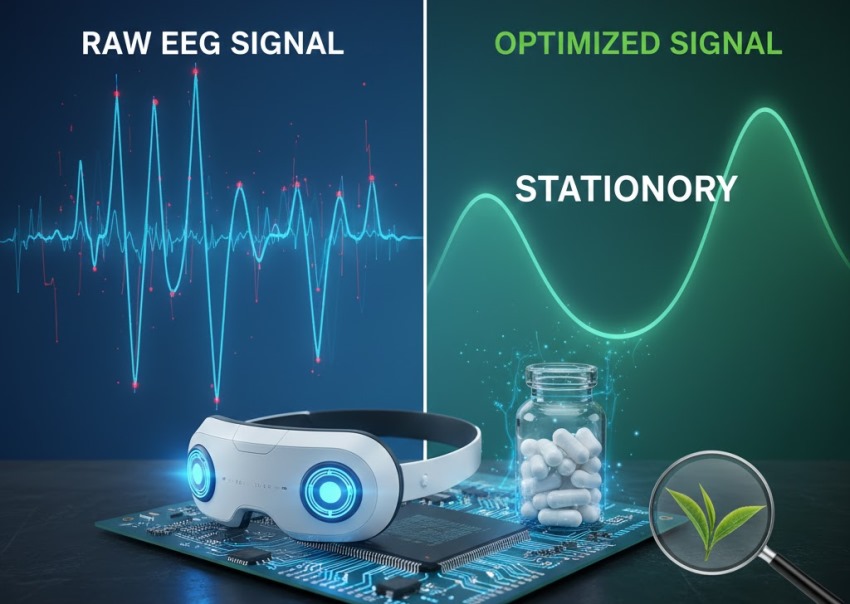
L-theanine optimizes neurotech by dampening myogenic (EMG) noise, significantly elevating the Signal-to-Noise Ratio (SNR) for EEG classifiers. By promoting alpha-phase stationarity, it ensures consistent state-blocks across experimental trials. This minimizes the need for frequent recalibration and sustains high-accuracy decoding during prolonged, high-load cognitive tasks.
Dosing, Safety, and Constraints
Typical supplemental doses range from 100–400 mg/day L-theanine in healthy adults, often split around cognitively intensive periods, with 1:1 to 2:1 L‑theanine:caffeine ratios when stacked. Short‑term trials report low adverse‑event rates, mostly mild gastrointestinal or subjective symptoms. Nonetheless, long‑term, high‑frequency use—especially in combination with chronic high caffeine intake—has not been extensively characterized.
People with cardiovascular disease, major psychiatric conditions, pregnancy, or those taking psychoactive or antihypertensive medications should consult a clinician before experimenting. L-theanine is not a treatment for anxiety disorders, insomnia, or attention‑deficit conditions, and it should not be used to compensate for chronic sleep deprivation or poor lifestyle.
Bottom Line: Where the Evidence Actually Stands
Current data support L-theanine as a modest but credible cognitive modulator: it reliably nudges many users toward calm, focused alertness, especially with caffeine, and produces measurable, task‑relevant changes in EEG and network dynamics. Its most compelling role is not as a standalone “brain booster,” but as a biochemical layer that improves the quality and stability of brain states feeding into neurotechnology.
FAQs
1. How many cups of green tea equal a standard 200mg supplement dose?
You would typically need to drink between 4 and 8 cups of green tea to ingest 200mg of L-theanine.
2. Which specific fungi contain L-theanine naturally?
The most notable fungal source is the edible mushroom Imleria badia, commonly known as the Bay Bolete.
3. Can L-theanine be taken safely alongside blood pressure medications?
Because L-theanine can lower blood pressure, it may enhance the effects of antihypertensive drugs and should be monitored by a doctor.
4. Does L-theanine have any effect on blood sugar or insulin?
Recent studies suggest L-theanine may help suppress blood glucose spikes and improve insulin sensitivity in metabolic contexts.
5. Is there a functional difference between synthetic and natural L-theanine?
While high-purity synthetic versions are chemically identical to the natural form, some low-grade synthetic products may contain inactive D-theanine isomers.
